
Last updated April 21, 2026 — Revised for clarity.

This essay explores a theory that explains why time only progresses in one direction, comparing it to gravity as an analogy.
Time Gravity implies that there is some force pulling time from the past to the future. We know of the gravitational pull between objects in our three-dimensional world. Let's carry this concept to the fourth dimension, which is time.
Time is mathematically described as the fourth dimension at a 90-degree angle to our three-dimensional space. In this fourth dimension, a force exists that overcomes the inertia that would otherwise cause time to stand still. This force is similar to gravity in our three-dimensional world.
I propose that this "gravity" propels us forward in time. Without this Time Gravity, everything would remain in the present moment. Time wouldn’t march on. Clocks wouldn’t tick. The Universe wouldn’t evolve.
I base my theory on two known concepts: Gravitational Time Dilation and Fluid Dynamics. Let's begin with a quick explanation of the first concept.
Gravitational Time Dilation
Einstein described Gravitational Time Dilation in his general theory of relativity: "Clocks that are far from massive bodies run faster than clocks close to massive bodies." 1
That means time passes more slowly wherever gravity is the strongest, so gravity affects time. Clocks on GPS satellites tick faster than clocks on Earth since the satellites are about 12,550 miles above the Earth, where gravity is weaker. A correction is made to the GPS programs to account for this difference.2
Fluid Dynamics and the Flow of Time
The Navier-Stokes equations3, named after Claude-Louis Navier (a mechanical engineer) and George Gabriel Stokes (a physicist), describe a fluid's flow velocity with a set of equations that also relate to weather patterns, ocean currents, water flow, and other physical phenomena.
I take these equations a step further and apply them to the flow of time. You may have heard how plumbers talk about water always seeking its level, especially if you ever had a flood in your house. Time might also seek its level, toward the future.
Similar to how water seeks its level, time seeks its level by tumbling to the future.
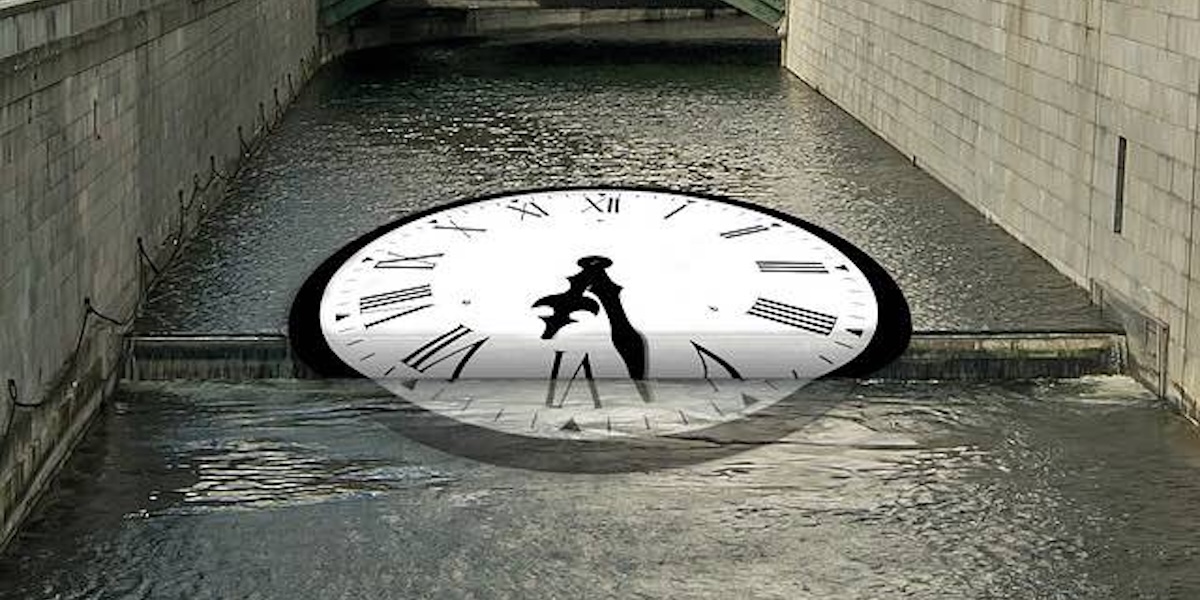
If all this is true, why don’t we drift backward in time? What is stopping us from going backward?
Something must be causing this gravitational pull to weaken as we go forward in time, so there is less force attracting time backward.
I found a mathematical formula that explains why time can only go forward. The formula indicates that as momentum increases, the force required to go backward would be so extreme that it cannot be achieved.
You may remember the equation taught in High School science class that is used to calculate the gravitational force on an object. It’s a function of the masses of both objects and the distance between them.

| Item | Description |
|---|---|
| F | Force due to gravity |
| G | Gravitation constant (6.673 x 10¹¹ Nm2/kg2) |
| m1 | Mass of one object |
| m2 | Mass of other object |
| r | Distance between the objects (from the center of each) |
Since the value of the formula decreases as the denominator increases, we see that the gravity force (F) is reduced by the square of the distance (r2) as the distance increases.
I propose that this same formula would apply to Time Gravity. I call it the “Force of Time Gravity.” There must be a force on both ends, the past and the future.
As time moves forward, we leave the past behind. The farther we move away from the past, the weaker the gravitational pull of Time Gravity. Its force is lessened by the square of the time that elapses, similar to how the force of gravity between two masses decreases by the square of the distance.
That means that the pull of the past continues to become weaker and weaker, and the thrust into the future becomes stronger. Hence, based on that formula, we continue to move forward in time with a force F.
There's one last detail that needs explanation. What contributes to the inertia that continues the flow of time?
The formula I used above indicates that the force of gravity between two objects is a function of their mass. However, no mass is involved with time. That dilemma can be solved by showing that time behaves similarly to mass.
The concept of fluid dynamics that I explained earlier illustrates how time builds inertia similar to mass. Think of a rolling stone going down a hill. Time could have that same inertia.

There is a good reason why time must only go forward.
If it were possible for time to go backward, there would be no past, present, or future. It would be a mumble jumble of chaos because events would repeatedly occur in different ways, causing an uncertain and inconsistent present and future. That is impossible, logically.
Everything that happens leads to achieving another outcome later on. If the past were continually modified, we could not depend on the outcome. That would lead to utter chaos.
The Stability of Time
We know that the three dimensions of space are reliably defined. We can measure length, width, and height with complete accuracy. But what about the fourth dimension through which time is measured? Is that as stable as our three-dimensional space?
The fact of the matter is that space is not consistent. It can be warped. Einstein proved that the force of gravity bends light as it travels through space. That makes space appear to become warped. Therefore, time most likely can be warped, too, just as gravity bends light.
This warping effect won’t bring back the past but will affect the passage of time. However, we will never know it because we are traveling along for the ride, which means we will remain consistent relative to the movement of time as time slows and speeds up.
The points I made explain why time will always slip into the future. Based on my theory, the strength of future time gravity continually has more force, pulling time forward to its level point, while past time gravity becomes weaker and has less of an effect.
Time flows forward by the same principle as the Navier–Stokes equations describe fluid dynamics. And with the same certainty.
So, due to the difference in those forces, the tendency is to move forward in time.
Was this article helpful?