
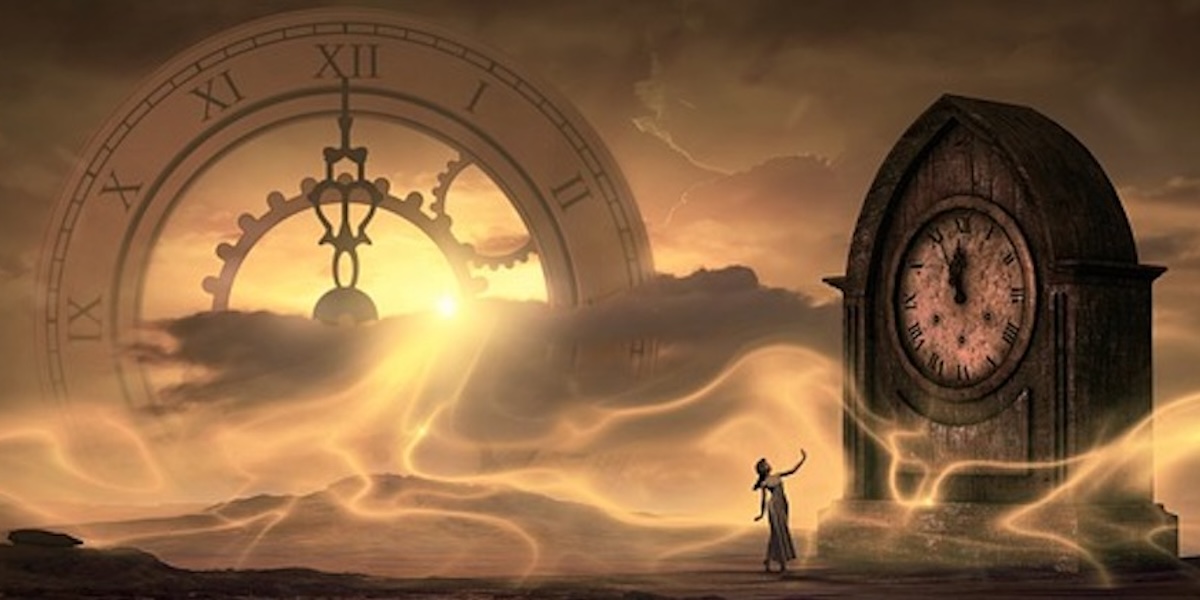
Animals never consider time. They function instinctively based on their circadian rhythm, which is quite reliable. But humans are different. We mingle in society in ways that require scheduling of our daily lives.
Humans evolved with the need to measure anything we deal with, especially by describing when events would occur or have occurred.
A lack of scheduling would cause tremendous confusion. So, we created the concept of time for our own sanity.
With that concept, we perceive reality as a sequence of events. But is that merely an illusion?
Even if time is an illusion, there is still so much more to it. Let’s examine this in more detail.
Physicists describe the passage of time as a sequence of chronons, which are hypothetical particles of time. You can think of it as the frames of a movie. But that implies it’s an illusion.1
The theoretical physicist, Carlo Rovelli, says that time is an illusion. He explains that our perceived reality is a sequence of events (past, present, and future), and we assign the concept of time to that sequence.2
Time is not a material thing. You can’t handle it and move it around as you can with any object at your disposal. You can’t hold on to it. It will just slip away.
We are all familiar with the fact that Einstein proved time is relative. It’s just a concept we use to measure a sequence of events and their duration, which we imagine based on our observation.
That concept of time is a figment of our imagination. It’s an illusion. We made it so real in our minds that we try to measure it. We even try to envision a beginning and an end to time.
Neil Turok, a physicist at the University of Cambridge, said, “There doesn’t have to be a beginning of time. According to our theory, the universe may be infinitely old and infinitely large.” 3
If we can accept that time doesn’t exist, then Professor Turok’s statement is even more plausible. We don’t have to try to pinpoint a beginning or an end. Remember, it’s merely a concept that we imagine.
The Second Law of Thermodynamics requires that time is a real property of the universe. Physicists rely on it for analyzing physical processes. But does that mean it’s real?
It is only a concept — a dependable concept that we base on mathematical formulas to measure and analyze our physical world in four dimensions.
Even though we can define time mathematically, our concept of time is faulty and unreliable.

Time seems to go by faster as we get older. However, that doesn’t mean that time is speeding up. It’s merely a feeling we have, because as we get older, the proportion of the length of events that we experience in our present life seems smaller than all the events in our past.
The reason this occurs is due to the ratio of time sequences in our lives. When we were ten years old, a year was 10% of our entire life. But at 50, a year is only one-fiftieth of our life. And it keeps appearing smaller as we age for that exact reason.
Michael Stevens explains this well in the following video:
Even though we only “imagine” the concept of time, we do use it for a purpose, and we need to measure it accurately.
Einstein explained how the passage of time fluctuates for an observer based on mass and motion.4
That fluctuation is known as time dilation. It causes misconceptions when conducting scientific measurements that require accuracy.
We need to keep a precise view of time. For this reason, atomic clocks use the cesium atom to attain a more accurate measurement of time as far as we are concerned.
We have always based our concept of time on the rotation of the Earth. These measurements need to be corrected continuously due to fluctuations in the Earth’s rotation. It’s so unreliable that we need to adjust for changes.
We have two scientific measurements of time.5
Since we base our measurement of time on the Earth’s rotation, we continuously need to make adjustments. The Earth does not revolve around the Sun in exactly 365 days, so we need to add a day every four years (leap year), except every hundred years. And that’s still not precise.6
We also need to add seconds every so often (leap seconds). The National Institute of Standards and Technology (NIST) schedules this as an extra second added at the stroke of midnight on the last day of June or December.7
Even if time is an imagined concept, we still need to define its pattern. That leaves us with two theories. Time is either infinite or cyclic.
If time is indeed infinite, then we can assume that everything will eventually occur in some way, and in some place, at some time.
If time is cyclic, then all physical phenomena will repeat forever. Moreover, if events do have minor differences in each repetition, then even cyclic time offers the opportunity for every possible occurrence imaginable to happen eventually.
Everything in the space-time continuum will repeat itself forever with endlessly varying possibilities. Each repetition would be a different existence, and there would be an infinite number of realities.
Either way, infinite or cyclic, there would never be an end to this. Time would never cease to exist.
If time doesn’t have a beginning or an end, had anything existed before the Big Bang?
The latest scientific findings support the Big Bang Theory, based on the present knowledge of physics. That implies there was a beginning.
That, in turn, means that there must be an end. One might say that everything that starts at some point will eventually end.
We run into trouble when we try to impose a finite measure on the timeline of the universe to a future that eventually ends.
It brings up questions of what exists beyond the end. That’s a paradox because it implies the universe will exist forever, or into infinity as it were.
It’s easier for the human mind to comprehend time with a starting point and an ending point. Infinity is somewhat incomprehensible. However, if we want to consider that there is a beginning and an ending to time, then we have to describe it somehow.
Here’s where we run into trouble.
Our thinking makes the concept of time a paradox.
If the end is final, then is there nothing left?
If what comes after the end is void of all matter, how long does that void last? That very question implies that “time” still exists!
If time still exists, then we indeed haven’t reached the end yet. Therefore, we might say that matter still exists in the universe.
If matter becomes non-existent due to being sucked into a black hole, for example, then time also ceases to exist. There is nothing left to measure it.
Just think for a moment: If time continues to tick away after all matter is sucked into a black hole, then the universe has a chance to recycle — to start over. That defies the idea of an absolute end. Hence, the paradox.
Our comprehension of endless space and time is limited due to our inability to imagine a changing universe without time.
Change keeps occurring, possibly until everything is equal. The end of the evolving universe would be a state of total equilibrium. It all becomes balanced, and there’s nothing left to evolve.
Once that balance occurs, nothing remains that would continue to change. Therefore, space and time become insignificant, possibly as it has always been, as an illusion.
Was this meaningful to you? Tap


