
Last updated March 23, 2026 — Revised for clarity.
Leap Years require adjustments besides adding a day every four years to keep in sync with solar time. I explain its mathematical formula in this article.
To keep our Gregorian calendar in sync with mean solar time (UTC scale), adding a day every four years is not sufficiently accurate.
We also need to add a second occasionally, known as a leap second. And we need to eliminate some leap years for further accuracy. Let's examine the details mathematically.
In my career as a Computer Systems Programmer, I once had to write an algorithm to determine the day of the week (Monday, Tuesday, etc.) for any specific calendar day.
That required me to have a thorough understanding of how we calculate the days in our calendar.
If it took exactly 365 days for the Earth to revolve around the Sun, we would have a perfect calendar and not need to make corrections.
Furthermore, if a year had precisely 365 and a quarter days, then adding a day every four years would work perfectly.
Unfortunately, our Earth goes around the Sun in 365.2426 days. So, adding a day every four years would mean we're adding too much.
We add an extra day, February 29th, every four years. However, we need to skip that addition once in a while for the following reasons.
If that additional fraction over 365 days were exactly a quarter of a day (.25), then every four years would add up to a full day precisely.
If that were the case, we would merely add that extra day at the end of February every four years.
However, since the Earth revolves around the Sun more slowly than that by a tiny fraction, we need to skip some Leap Years.
We live in a time when we have the resources to do extremely accurate measurements.
We have the technology today to measure the Earth's rotation so precisely that we can detect minor changes to how it is slowing down. We use atomic clocks to measure time accurately.
National Standards Agencies in many countries maintain a network of atomic clocks. They are kept synchronized with extreme accuracy.
In addition, we have the master atomic clock at the U.S. Naval Observatory in Washington, which provides the time standard for the U.S. Department of Defense.
The NIST-F1, a cesium fountain atomic clock developed in 2013 at the NIST laboratories in Boulder, Colorado, is more accurate than previous atomic clocks.1
That fraction I mentioned before, 0.2426, is slightly less than a quarter of a day. Therefore, every 100 years, we need to skip adding a day in February. Otherwise, we would be adding too much.
Skipping a leap year every 100 years would only be accurate if the extra time were precisely 0.25. However, we are still off by almost .01 from a quarter day. That .01 adds up to 1 in 100 years.
Therefore, we need to skip a leap year every 100 years. If we didn't do that, we'd be adding too many days to the calendar.
But wait! That still isn't perfect! We'll still get out of sync with solar time if we don't take it a step further.
As you can see, we still have that extra .0026 that we are off when skipping a leap year every 100 years. If you add that up, with some rounding error, that .0026 is a little over one day every 400 years (.0026 x 400 = 1.04).
That means skipping a leap year every 100 years also needs adjustment. We need to add a day back in. So, we need to have a leap year every 400 years to get that one extra day added back.
The easiest way to add that missing day back in is "not to skip" a leap year when the year is a multiple of 400. In other words, we keep February 29th on the calendar every 400 years, even though it is a multiple of 100.
To say all this in a simple sentence:
We add a day every four years, but not every 100 years, unless it's a fourth-century year, at which point we do add that extra day anyway.
But there's more involved! Besides adding days, we need to add seconds every so often. I'll explain that next.
| Year | Skip Leap Year if Multiple of 100 | Unless it's a Multiple of 400 | Leap Year? |
|---|---|---|---|
| 1600 | - | Yes | Yes |
| 1700 | Yes | No | No |
| 1800 | Yes | No | No |
| 1900 | Yes | No | No |
| 2000 | - | Yes | Yes |
| 2004 | No | - | Yes |
| 2008 | No | - | Yes |
| 2012 | No | - | Yes |
| 2016 | No | - | Yes |
| 2020 | No | No | Yes |
| 2024 | No | No | Yes |
| 2100 | Yes | No | No |
That mathematical formula for leap years is still not perfectly accurate, and we need to add a few seconds once in a while to compensate for the following events:
To improve the accuracy of our time clocks, we need to adjust our calendar by adding a second or two every year. It's called a leap second.3
Scheduling the addition of an extra second to a year is done to make these adjustments when required.
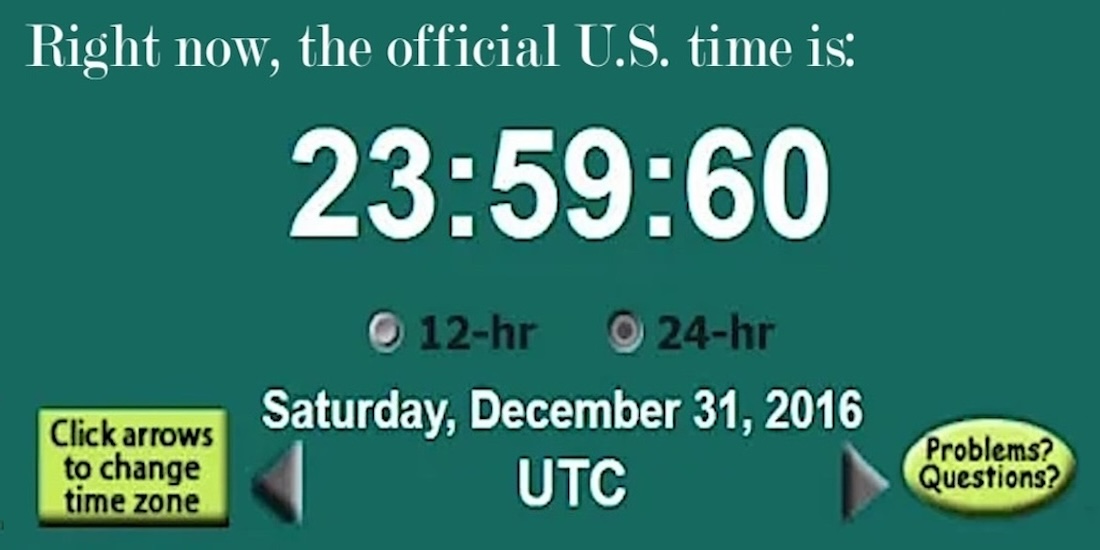
The additional second is usually added just before midnight (23:59:60) Coordinated Universal Time (UTC), on June 30th or December 31st.
The International Earth Rotation and Reference Systems Service is the agency that decides when to make leap-second time adjustments.
They apply a leap second whenever necessary to keep our clock from being more than nine-tenths of a second off.
Here is a table of dates when an additional second was added. Each addition is done at midnight (UTC):
With our current technology, we can keep our clocks in sync with how we represent time.
But it's an ongoing challenge to keep our time measurements accurate since physical events like earthquakes can nudge the Earth just enough to require further adjustments.
Was this article helpful?