

Future time travel doesn't break any laws of physics, so it's likely possible with advancing technology. But we can't change what has already occurred, so going back is impossible.
When you think about it, we are already traveling through time at a constant speed of one second per second. If you want to get to tomorrow, sit in your favorite comfy lounge chair and wait 24 hours.1
Seriously, though, we want that advancement through time to accelerate.
Quantum physics shows that a particle can move from one physical location to another within our three-dimensional space without the passage of time. That's why it's called a quantum leap.
If we could do that in the fourth dimension, that would mean moving from the present to the future without existing in between. Yes, we would call that time travel. It's a fascinating subject that has enchanted people throughout the ages.
To understand the concept of traveling through time, we need to relate everything in our three-dimensional world to the fourth-dimensional world of "time." The following exercise will make it easy to imagine:
If we were to do the same with time, the fourth dimension, and bend it over onto itself, we would make the inhabitants at different periods in time exist simultaneously.
If that were so, perhaps there is a connection between the two, a path from one to the other. This connection is what was meant by the Einstein-Rosen Bridge, a wormhole connecting one three-dimensional universe to another.2
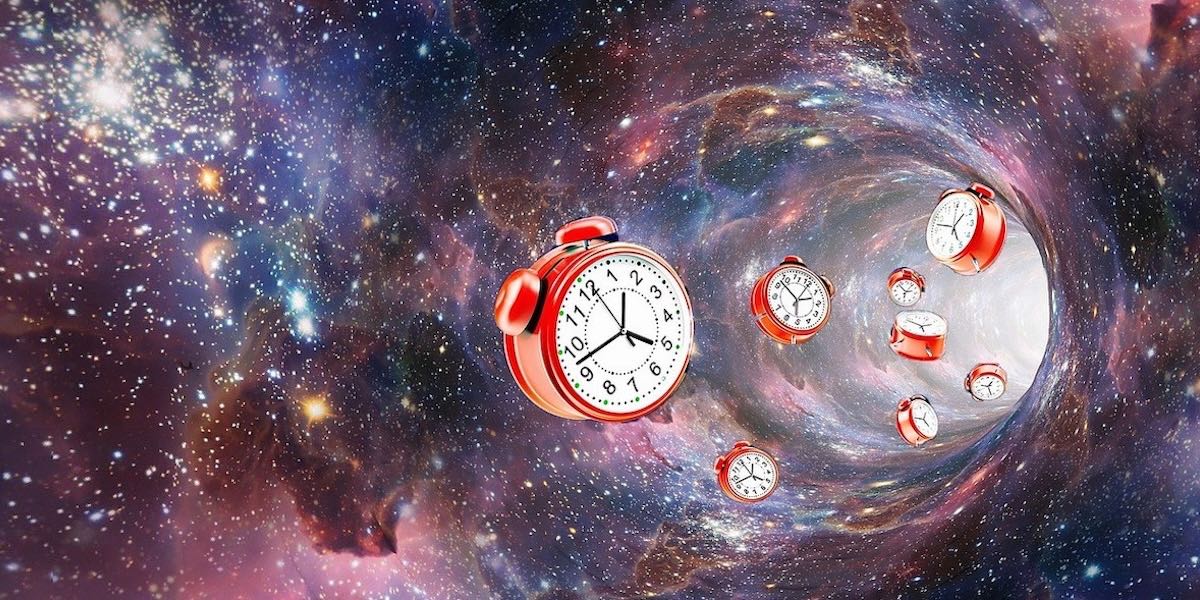
Time travel from one point in time to another is similar to moving from one point in space to another. When we travel from point A to point B, a certain amount of time goes by. We can’t ever end up at the destination at the same instant as when we left. And most certainly, we don't arrive at the destination before we leave.
Traveling through a wormhole might transport one back or forward in time. However, going backward would be improbable, as I'll explain in a moment.
That all sounds conceivable when explained that way. But what if it were possible to apply this process? Would we get to meet those who lived in the past? Realistically, we’re overlooking too many physical laws that would stand in the way.
That all sounds conceivable when explained that way. But what if it were possible to apply this process? Would we get to meet those who lived in the past? Realistically, we’re overlooking too many physical laws that would stand in the way.
If we traveled back in time, we would arrive dead. And to be more accurate, we wouldn't be who or what we were before. The reason is that every atom or molecule in our bodies was once somewhere else, possibly part of another animal, plant, or object.
So, going back in time would displace all our atoms to where they were at that specific time in the past. They would not be combined to make us what we are in our time.
I can give you another reason why we'd be dead.
The Earth would not be in the same location in orbit. So, when we go back in time, we would most certainly find ourselves lost in outer space with no life support.3
Here’s undeniable proof that backward time travel will never have been discovered in the future. (Note the weird grammar when writing about past events of future occurrence. It just turns out that way!)
If some future generation found a way to travel back to the past, we would be aware of visitors from the future who suddenly appear before us when they weren't here a moment earlier! Wouldn't you agree?
Besides, these visitors would change our present. That would affect their history and future. Small changes can affect the future in major ways.
That is known as the butterfly effect, derived by Edward Lorenz. He explains how the flapping of a butterfly's wings can eventually create a more forceful future event, such as a hurricane.4

If one were to go back in time, anything they did would drastically change the future from which they came.
Anything we do, any small action, can have an enormous effect on the future. Future behavior is highly sensitive to past events.
Another example might make this more obvious. When you step on a bug and kill it, your action could cause a whole new variety of species thousands or millions of years later. That is because you eliminated that single insect's hereditary evolution.
If you were to go back in time and step on a bug, the world today would be altered. We could have different types of mosquitoes, possibly savage mosquitoes that torture humans.
That example shows how small initial changes can yield widely diverging outcomes many years later.
The point is that if a new force of nature were to be discovered that allowed us to go back in time, we would be able to create a change to the past that would drastically affect our present existence.
Nothing would ever be consistent. That breaks the fundamental laws of nature.5
If you could travel through time, would you want to go to the past or the future?
Half the people I asked about this said they'd rather travel to the past so they could do things differently and change their lives.
The other half preferred going to the future so they could see how things turn out with technology and society.
Future generations may one day develop the technology to travel forward in time. That doesn't interfere with recorded history. It doesn’t break the laws of physics. Forward time travel is conceivable for that reason.
As I mentioned earlier, quantum physics shows a particle can move from one physical location to another without the passage of time. So we may one day have Quantum Time Travel, a leap into the future.
If it were possible for a particle to leap through three-dimensional space, why wouldn't it be possible to leap through the fourth dimension? That is, through time.
Anyway, we need to stay in the present where we can work on creating our future.
Stephen Hawking spent years trying to prove that time travel can't be accomplished, but he couldn't find any laws of physics that stood in the way. He eventually admitted that it might be possible, even if not practical.
Was this meaningful to you? Tap