Last updated April 3, 2026 — Revised for clarity.
Confused about which eye care specialist you need? This guide will help you choose the type of eye doctor that is best suited for your specific vision care, whether you need an Optician, Optometrist, or Ophthalmologist.
Ophthalmologist: Specialist in Eye Disorders and Diseases
An ophthalmologist is a specialist educated as a medical doctor dealing with disease and injury of the eye. They also perform surgical procedures. They must complete a residency in ophthalmology in medical school and have an M.D. degree or a Doctor of Osteopathic Medicine (D.O.).
Optometrist: Prescriptions for Vision Correction
An optometrist prescribes corrective lenses for eyeglasses or contact lenses. They have education in optics and is the one who figures out what prescription you need to improve your vision.
In the United States, Optometrists complete medical training before their practice. They have an O.D. degree (Doctor of Optometry), which takes four years to complete after receiving a bachelor's degree.
Optician: Sells Eyewear to Fill Prescriptions
An optician is a health care practitioner who fills the prescription by fitting and dispensing lenses and eyewear to correct your vision. They usually have an associate's degree or an apprenticeship of two to four years.
The following is a more detailed review of each type of eye doctor. They are professionals in their related fields, so it's crucial to use the right one.
If you have any health issues or injuries with your eyes, you'd want to see an ophthalmologist.
If you have a history of glaucoma in your family, it's important to get annual checkups with this type of eye doctor. As an example, my ophthalmologist diagnosed me with glaucoma and saved me from losing my sight. He prescribed drops that controlled my eye pressure.
An Ophthalmologist is a medical doctor who can treat eye diseases. That's important if you have medical issues, such as I had with glaucoma.
Ophthalmologists can also treat glaucoma with a procedure that keeps the pressure normal, so you don't need to use eyedrops. It's a special laser treatment called Laser Iridotomy. I had that done.1
Another example of an issue that requires the attention of an Ophthalmologist is if you ever suddenly have flashes and a lot of floaters. You need to get that checked fast. It could be a minor issue such as a posterior detachment of vitreous, the fluid in the eye.2
However, it can be more serious—such as a detachment of the retina, and that needs immediate attention.
An Ophthalmologist can determine which of these issues is the cause of these symptoms, and he or she can treat it.
An optometrist is the best eye doctor to go to when you want to get a vision test for a new eyeglass prescription.
In the past, I used to go to an ophthalmologist to perform a vision test and write out a prescription for lenses. Then I would have it filled by a local optician who also sold me the frames. I often had issues with an incorrect lens, but I never had trouble when I had my prescription written by an optometrist.
I concluded that since optometrists are specialists in optics of the eye, they understand the patient's needs for vision correction much better.
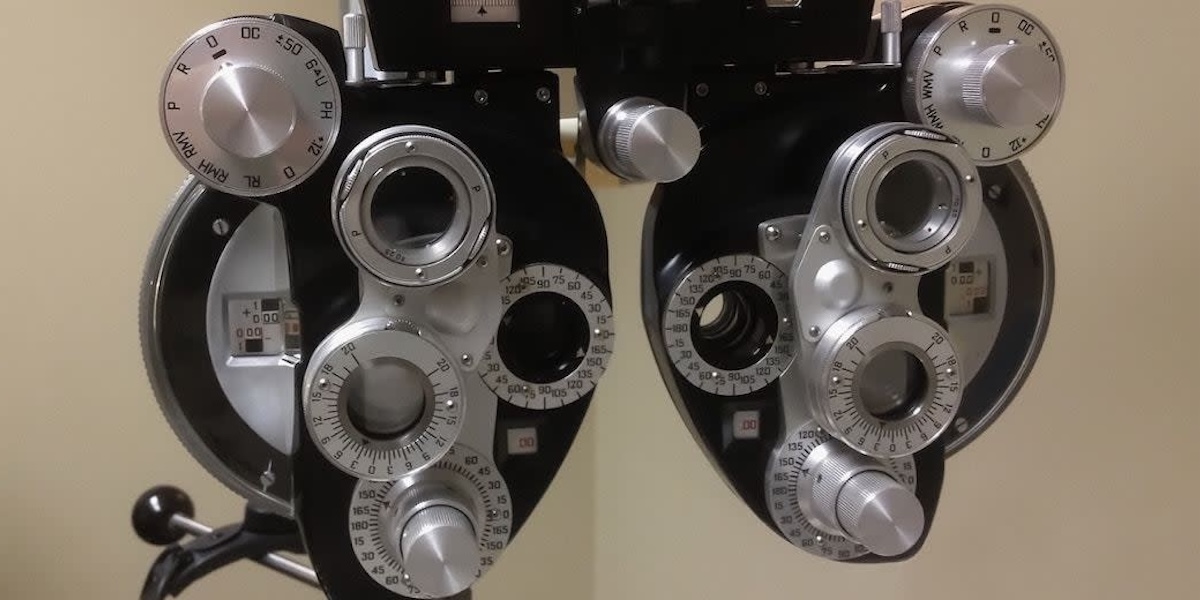
An instrument known as a phoropter (shown at the top of this article) is used to measure the refractive error to determine the proper eyeglass prescription for corrective lenses.
As I got older, I eventually needed progressive lenses. These are special lenses that have differing prescriptions from top to bottom. The top is for seeing far, and the bottom is for near. They are like bifocals, but without the line between distance and near. Progressive lenses change gradually from top to bottom.
The first time I had progressives prescribed, I had my ophthalmologist do it. I could never get used to the glasses.
Everyone tried to tell me that it takes time to get used to them. Don't believe that. It's wrong. If the lenses were made right and set in the frame correctly, you wouldn't need time to adjust to them.
I found out that this was the case when a friend insisted that I go to her optometrist to get a prescription for progressive eyeglasses. Her doctor considered my particular needs by asking what I did for a living.
Since I told him I do a lot of work on a computer, he specified that the lenses should be set higher in the frames. That was necessary since most of my work involved looking out the middle for nearby work. Without that consideration, the lenses would be set too low.
When one reads, one looks out the lower part. But in my case, I look out the middle of the lens since I am close to the computer. That was the first time I had an optometrist give me a vision test and write a prescription, and he understood my needs. My progressives were great from the first time I wore them. I have never had a problem with eyeglass prescriptions since then.
As I mentioned earlier, Ophthalmologists understand diseases of the eye. That is their specialty. But Optometrists know better how to determine proper prescriptions for vision correction.
Opticians know how to set the Position of Wear (POW) properly. That includes five different values that are important to set correctly.
For example, progressive lenses require a proper angle known as pantoscopic tilt. Ask your doctor about that. If they do not know what you mean, find another doctor.
Two more common settings are:
Modern Opticians' offices have up-to-date equipment for measuring these things digitally, with a precision of 0.1mm.
If you already have a prescription from a recent vision test, you can bring it to an optician to get your eyeglasses. They will order the lens and fit it correctly in your frame. Many opticians also sell the frames.
An eye doctor uses a Tonometer machine to perform an exam to measure your internal eye pressure. The exam is known as Tonometry. The device displays the pressure in millimeters of mercury (mm Hg).
There are two kinds of Tonometers:
In both cases, the doctor gives you numbing eye drops, so you don't feel it.
Normal eye pressure is in the range of 12 to 22 mm Hg. Pressure higher than 20 mm Hg may indicate a diagnosis of glaucoma.3 However, some people can have glaucoma at lower pressures. That's why it's essential always to have a thorough eye exam by an ophthalmologist.
Many people get confused with D.O. and O.D., and some sites on the Internet mix them up too. So I decided to explain this clearly.
An Optometrist is an eye doctor with an O.D. degree. That stands for Doctor of Optometry.
On the other hand, a D.O. is a Doctor of Osteopathic Medicine. They practice medicine and perform surgery, as well as prescribe medications. That has nothing to do with being an eye doctor unless they also completed a residency in ophthalmology.
A family physician can be an M.D. or a D.O. There is not much difference except that a D.O. pays more attention to a patient's lifestyle to determine proper care. An M.D. focuses more on treating ailments by prescribing medications.
Being a specialist in a particular field does not necessarily make one the right doctor. Patients need to know the limitations of each.
It's crucial to find a knowledgeable eye doctor in the right field. Ask your primary doctor or friends for recommendations. Then check their references, which you can do online.
Was this article helpful?