Last updated January 6, 2026 — Revised for clarity.

When I suddenly saw arcs of light flashing in my vision, I learned I had Posterior Vitreous Detachment (PVD). I'll describe the symptoms and tell you what you need to know to save your eyesight.
Later in the day, I thought my glasses were dirty. But I still saw cloudiness over everything when I tried to clean them.
Once I realized my glasses were indeed clean, I realized the cloudiness was due to many floaters.
Floaters are like little hair-like strands floating around the eye. You probably notice them when you look at the sky on a bright day. We all have a few that generally don't bother us. However, my experience became so annoying that I called my ophthalmologist.
When I told my doctor I suddenly had a lot of floaters, he asked if I had also experienced any arcs of light or flashes. Since I did, he wanted to examine me immediately. I had no idea why he was so insistent about rushing to his office immediately.
I had Posterior Vitreous Detachment (PVD). That's when the gel-like fluid that fills our eyes detaches from the retina. That fluid is called the vitreous.
PVD is not a serious condition. However, you could have the same symptoms when the retina detaches from the rear of the eye. And that is a serious condition that needs immediate attention. So a trip to an ophthalmologist is crucial for a proper diagnosis.1
When one experiences these symptoms, it could mean either of two things:
1. You might have a detached vitreous.
The vitreous fills the eyeball and is transparent, so you see right through it. As we get older, it tends to dry out and shrink. As it shrinks, it may pull away from the rear of the eye. That is why it's called a Posterior Vitreous Detachment (PVD).
The retina is at the rear of your eye. It's like a movie screen on which images appear. The retina transfers these images to the brain through the optic nerve.
When the vitreous detaches and pulls away from the retina, the disturbance sends signals to the brain that simulate arcs of light. In addition, a detachment causes debris from tissue that floats around the eye, resulting in floaters.
2. Or you might have a detached retina.
The same symptoms with arcs of light can be the result of a detached retina.
If you have a detached retina, it can be repaired in most cases if it's taken care of quickly. However, if you wait too long, you can lose your sight in that eye. So don't wait! Rush to your ophthalmologist as soon as you experience flashes.
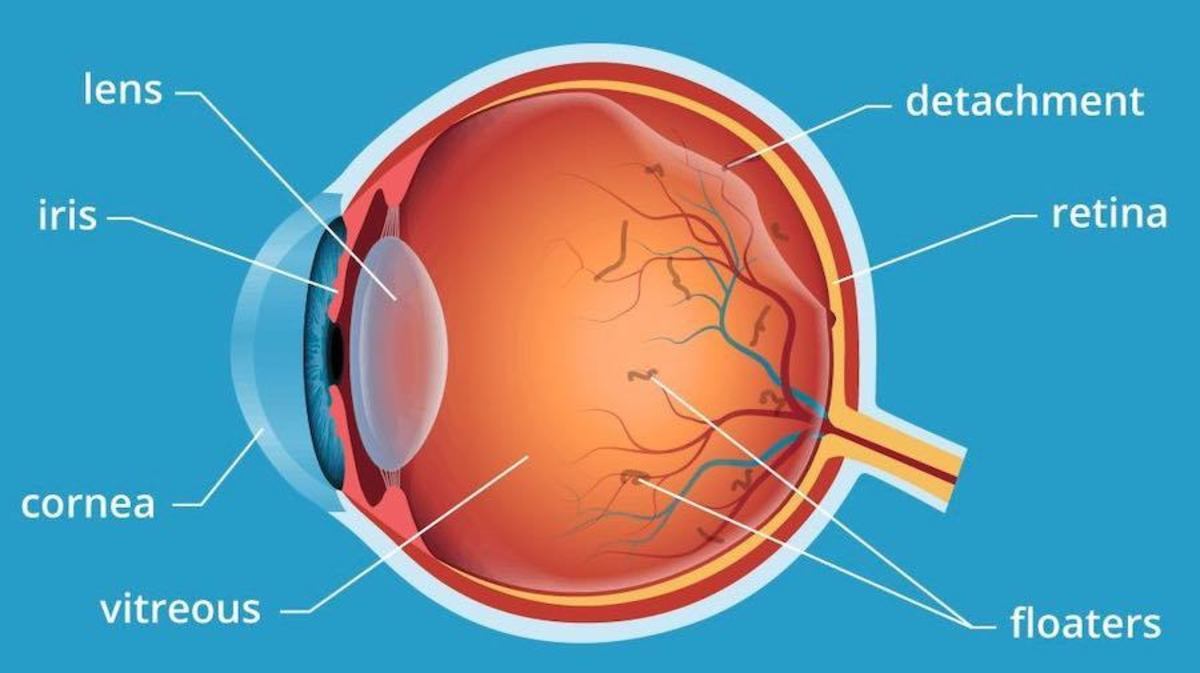
As we age, the vitreous in each eyeball shrinks. People with myopia (near-sightedness) have a greater tendency for a shrinking vitreous to pull away and detach because the eyeball is elongated. That is, there is a farther distance from the lens to the retina.
Far-sighted people have a different shape of the eye, being shorter from front to back. Therefore, it's less likely for a shrinking vitreous to detach.
The vitreous connects to the retina only in three places:
When the vitreous shrinks, it pulls on the retina and can rip part of the retina off the rear of the eyeball. If you have a detached retina and get it diagnosed in time, you can have it repaired with non-invasive surgery performed with lasers.
A detached retina is a serious condition. You need to have it repaired quickly!

When the vitreous separates (detaches) from the rear of the eye, it usually leaves loose cells floating around. You see these as thread-like strands known as floaters.
If it didn't pull and detach the retina, it's not a serious problem. However, since we don't know if the flashes are due to a detached vitreous or a detached retina, it's important to get it checked out immediately.2
As it turned out, in my case, I just had a detached vitreous. My retina was okay. So nothing needed to be done. My doctor told me the floaters would disturb me less over time since the brain "learns" to ignore them.
He was right. It took about a year for me to stop being bothered by them. I still see floaters when I pay attention to them, but they don't bother me anymore.

It's been over ten years since I had the detached vitreous. I still see flashes of light at times. My ophthalmologist explained that this is because the vitreous is pulling on the retina since it's not fully detached.
My doctor also said there is a lesser chance of a detached retina in the future after a vitreous detachment, but since my vitreous is not fully detached, it still can happen.
I always have an annual checkup to ensure my eyes are okay. However, my doctor says if I ever experience more than the usual floaters, I should get examined quickly. It could mean the vitreous is pulling the retina off the back of the eye. That would need immediate attention to reattach the retina.
I never had a problem with a detached retina, glad to say. Also, I've been getting used to the floaters and hardly notice them anymore.
Other, more severe, diseases of the vitreous require more involved repair. Diabetes can cause tiny blood vessels to grow into the vitreous. In this case, if the vitreous shrinks and pulls away from the retina, it can cause a retinal detachment.
The tearing of these tiny blood vessels can cause bleeding into the vitreous. Although rare, anyone with diabetes should consider that possibility.3
When you suddenly see flashes of light and have many floaters, there is no way for you to know if it's a detached retina since the symptoms are similar to PVD, and there is never any pain involved. So, it's best to get it checked out quickly when flashes suddenly occur.
Superior technology exists today that helps diagnose and treat various eye diseases. But you need to be proactive. Take care of your eyes by having regular annual checkups with an ophthalmologist.
Was this article helpful?