
Published May 17, 2026
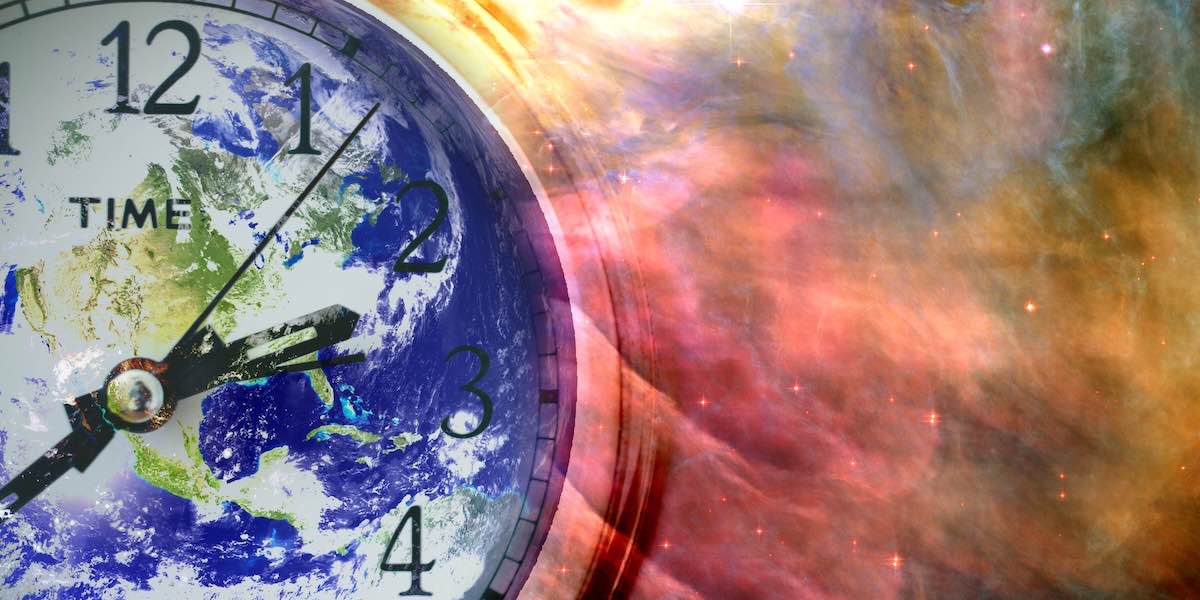
This is a short breakdown of the fundamental mysteries of time in an attempt to understand its first moment.
Is time a human construct? Did we create it to help us make sense of our daily experiences?
To discuss time, we need to talk about a series of moments.
What we experience now quickly becomes our past. And each segment of our future arrives as a segment of now.
But how does everyone experience now? Do we all experience the same “now” at the same time?
According to Einstein’s Theory of Relativity, everyone experiences the present based on their relative position in space.
For that reason, Einstein combined space and time into a single entity called spacetime.
In this scenario, the past, present, and future exist simultaneously in space. Therefore, time never existed to begin with. We made it up.
The past and the future are simply references in time that we have imposed on our way of thinking. We use these references to communicate. For example, a time reference helps us to coordinate when to meet for an event.
However, it’s impossible to time-travel to that specific time and enjoy the event. The only way to be part of the event is to wait for it to occur in the present.
Only the present exists. We have to wait for the future to approach the present. As it drifts into the past, we tend to forget details of the event. But the present will always be with us in every sense.
Time is mathematically described as the fourth dimension. It's one quarter of the space-time continuum.
I'll give you an example. If you want to meet someone at a restaurant for lunch, you have given them the location in our three-dimensional world, plus the time. That’s a total of four coordinates. Time itself is the fourth dimension.
I know what you’re thinking: One only needs the address and the time to know when and where to meet a friend for lunch. However, the address is physically the longitude and the latitude coordinates on the planet Earth.
GPS units use data from satellites to determine the addresses of the buildings, but you need a third coordinate. Altitude is the third coordinate. You may need to tell your friend to meet you on the ninth floor.
Time, of course, is the fourth coordinate that’s required to be sure you both know where and when to meet.
There’s something very interesting about the phenomenon that occurs with objects in our 3D world traveling through time. Say you have a pen lying on your desk. Tomorrow, you look at it, and it will still be there, assuming no one moved it. We expect that.
However, scientists have found that molecules can move from one location to another without ever existing in between. How is this possible? It has to do with Quantum Leap.
An object seems to disappear when entering the fourth dimension and then reappears in a different place. I'll give you an example:
Imagine you live in a two-dimensional world, such as a cartoon character drawn on paper. You can move right and left or back and forth. But you can’t move up and down. There is no third dimension when you live in that 2D world.
So, if an object were to move up or down, into the third dimension, then it would disappear from view within its two-dimensional world.
The same is true for us in our 3D world. We can only see what’s in our three dimensions. We can look left or right, back or forth, and up or down. But we can’t see into the fourth dimension.
In other words, we can’t look into the past or the future. We are only aware of the present. We only experience the present.
That's where quantum physics comes into play. Scientists have already observed how molecules can move from one place to another without any apparent movement between the two points. That’s known as a quantum leap.
Any object that might travel into the fourth dimension will disappear from view. It will reappear when it passes back through our 3D space in its new location. Therefore, it seems to move from point A to point B without existing in between.
As for the time it took to make that move, we will never know. While it’s traveling through the fourth dimension, it is beyond our comprehension.
Remember that the fourth dimension is time. So, if the object's location is beyond our comprehension, we have no idea if its motion was instantaneous or if it took forever. All we know is that it reappeared upon returning to our three-dimensional world.
If that makes any sense, you might realize why time itself is really meaningless. Or, in other words, it’s just our imagination.

So, what about this object I speak of? Matter can only exist in 3D. A two-dimensional world can't contain any matter because "flat" is a concept that has zero space in what otherwise would be the third dimension perpendicular to that flat world.
If a two-dimensional cartoon character can’t visualize 3D space, then it is also true that we 3D creatures can’t see into 4D. That is, we can’t see time. If it does exist, we can’t see it. It’s not valid.
Time can only be valid for matter in a 3D world moving through the fourth dimension. But we cannot track it. We can only imagine it’s moving through 4D. Without that motion, the matter becomes non-existent. And without matter, time itself becomes non-existent.
The nature of time and the possibility of timeless realities remain debatable subjects. The question of when time began requires us to explore the fundamental mysteries of existence and to understand the nature of reality.
When I think deeper about this, my spiritual side begins to emerge. I start to consider the possibility of creation.
What I’m referring to is that before God created the universe, time didn’t exist. If there were no matter, then time never existed to begin with. But that’s another story.
Suffice it to say, maybe God created time after He completed everything else.
If you got this far, let me know with a thumbs-up.

