Updated August 6, 2026 — Revised for clarity.

This article reviews the issues scientists face in determining if colonizing Mars is possible with our present technology.
Before we can consider living on Mars, the challenges involved with transportation to get there need to be considered. Daniel Strain, a science writer at the University of Colorado, suggests the following critical considerations.1
It would take two to three years to get there. And that is the best result based on the closest orientation of the orbits of Earth and Mars at the time of departure.
To communicate with Earth during the trip, it can take up to 20 minutes for radio signals to be received, and double that for a response. Once again, that is the best that can be achieved when Earth and Mars are on the same side of the Sun.
Remote health checkups with doctors will also be challenging. For example, electrocardiogram (ECG) data has that same delay for relaying to Earth.
NASA has already discovered water on the planet that could help sustain human life, but most of it is in the form of ice. It's on the surface only at the northern pole of Mars.
In September 2020, Mars Express, the European Space Agency's Mars-orbiting spacecraft, found a large lake under the ice at its south pole containing saltwater.2
However, that would need to be processed to make it useful for human consumption.3
The environment on Mars is hostile to human life. We need protection from cosmic rays. Earth has a magnetic field that diverts cosmic rays to our poles, away from inhabited areas.
Mars has a different atmosphere that is not favorable to humans. We would have to wear space suits until the planet can be terraformed to produce an Earth-like atmosphere. Assuming that is even possible.
Robotic missions with rovers have found raw materials that can be used to construct communities. So, we would not need to send these raw materials from Earth.
Mars is the most Earth-like planet in our Solar System, so it's the best candidate for colonization. Over three billion years ago, it resembled Earth as we know it today, with life-supporting flowing water and a cosmic-ray protective magnetic field.
Mars lost both of these since then, but scientists hope to terraform Mars to bring it back to a habitable condition. However, its magnetic field is gone for good.
We know that we are protected here on Earth by its magnetosphere that diverts the dangerous solar particles and cosmic rays to the poles—away from inhabited areas. That's what causes the Aurora Borealis (northern lights) and Aurora Australis (southern lights).
The magnetosphere is a magnetic field that exists because Earth has a metallic core. Mars had a magnetic field once.
However, it was lost over 3.7 billion years ago, possibly due to multiple asteroid strikes that destroyed the dynamo effect of the planet's internal magnetic core.4
That means we would need a method to protect us from cosmic rays that are hitting the planet.
The fact is that we would never be able to enjoy a day outside without protective suits. Even if there were an atmosphere, we still couldn't go out without protection as we do on Earth.
All our daily activities would need to be inside buildings that protect us from cosmic rays while living on Mars. Possibly even building underground living quarters would be mandatory.

The major part of the Earth's atmosphere that we breathe is 78% Nitrogen and 21% Oxygen, while the atmosphere on Mars is 95% Carbon Dioxide. That's great for plants, which absorb Carbon Dioxide for photosynthesis in sunlight to produce oxygen.
However, Humans need oxygen to breathe and provide energy to our cells.
Mars does have an atmosphere, but it is very different from our atmosphere on Earth, as shown in the table below.
Carbon Dioxide is the most abundant and can be converted into oxygen, as plants do with photosynthesis here on Earth. If we were to plant trees on Mars to change the atmosphere, it would take time to make it breathable.
Even if we can breathe the air, the chemical makeup that I described above is not conducive to human survival.
The atmospheric pressure on Earth at sea level is 14.69 psi. The average pressure on Mars is 0.087 psi. Humans will lose consciousness when exposed at that level, known as the Armstrong Limit.5
Humans definitely could not survive at this low pressure. One would need to go through an airlock to enter and leave the living quarters to maintain the inside atmosphere. They would always have to spend their time in a pressurized environment.
| Earth | Mars |
|---|---|
| Nitrogen (N): 78% | Carbon Dioxide (CO^2): 95.32% |
| Oxygen (O): 21% | Argon (Ar): 1.9% |
| Argon = (Ar): 0.93% | Nitrogen (N): 2.7% |
| Carbon Dioxide (CO^2): 0.04% | Oxygen (O): 0.13% |
| Neon (Ne): 0.001818% | Carbon Monoxide (CO): 0.08% |
| Helium (He): 0.000524% | Sulfur Dioxide (S): Trace amount |
| Methane (CH4): 0.000179% | Methane (CH4): Trace amount |
| Other gases: Trace amounts | Other gases: Trace amounts |
Gravity on Mars is only 38% that on Earth. Therefore, if you weigh 170 lbs on Earth, you'd be 65 lbs on Mars.
Gravity is a result of the attraction between masses. The larger the mass of an object, the stronger its gravity.
Our Sun's gravity keeps all the planets circling it in our solar system without flying away into the outer limits of the galaxy. The gravitational pull of the planets also holds their moons in orbit.
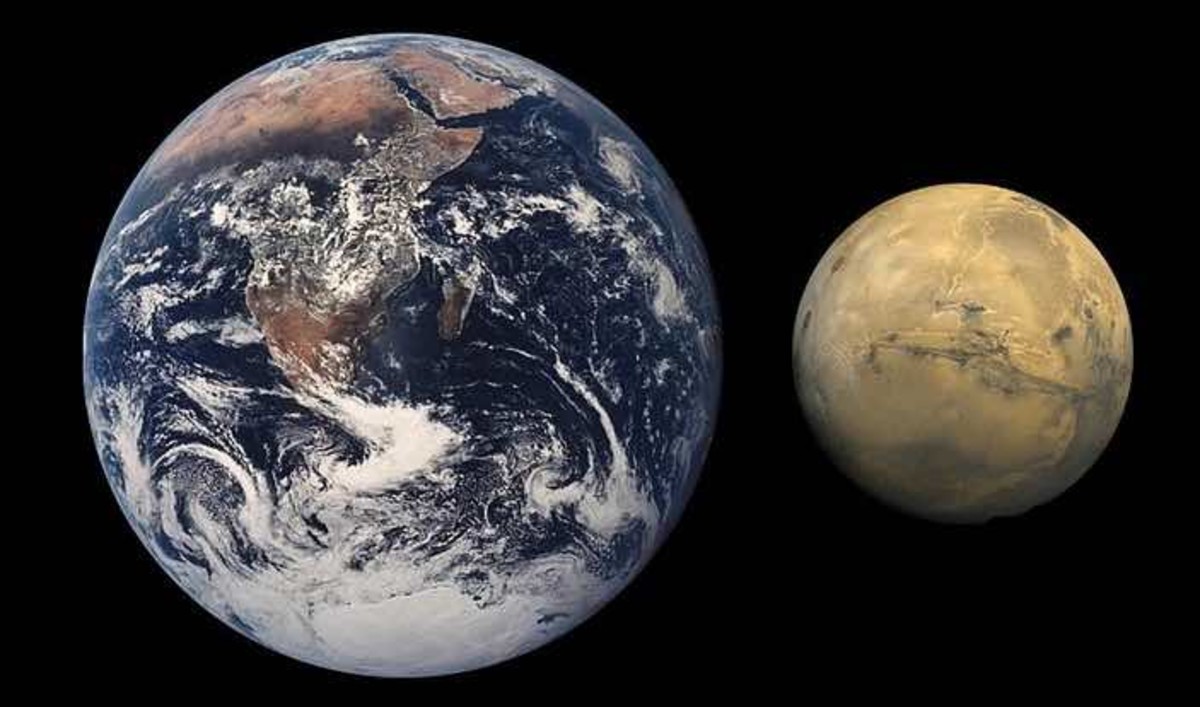
Since Mars is smaller than Earth, as shown in the image below, its gravity is weaker.
You might have seen videos of Neil Armstrong and Buzz Aldrin walking on the Moon on July 20, 1969. Their footing was strange as every step they took sent them hovering for a moment due to the weaker gravity.
That experience would not be the same when walking on Mars since it's much bigger than our Moon. But it would still be very different from the firm footing we've developed since learning to walk as toddlers.
Gravitational pull is weaker the higher you go, away from the center of mass. That becomes more mathematically complex on Mars because its southern hemisphere has less mass than its northern hemisphere.6
It's essential to consider these gravity anomalies when planning to bring equipment and supplies to Mars for future colonization.
Since Mars is approximately 142 million miles from the Sun, it's colder than Earth, which is only 94.47 million miles from the Sun.
The average temperature of Mars is -85° Fahrenheit (-65° Celsius). In the summer, the temperature can warm up to -24° Fahrenheit (-31° Celsius).
When you consider that Venus gets as hot as 867° Fahrenheit (464° Celsius) and Neptune gets as cold as -328° Fahrenheit (-200° Celsius), Mars is more favorable.7
Scientists are already examining ways to transform Mars by creating greenhouse gases that could increase the pressure of the atmosphere well above the Armstrong Limit (Which I spoke about earlier).
This process is known as terraforming. It's still hypothetical, but it would create a sustainable colonization of Mars by transforming it over time to become more like Earth.
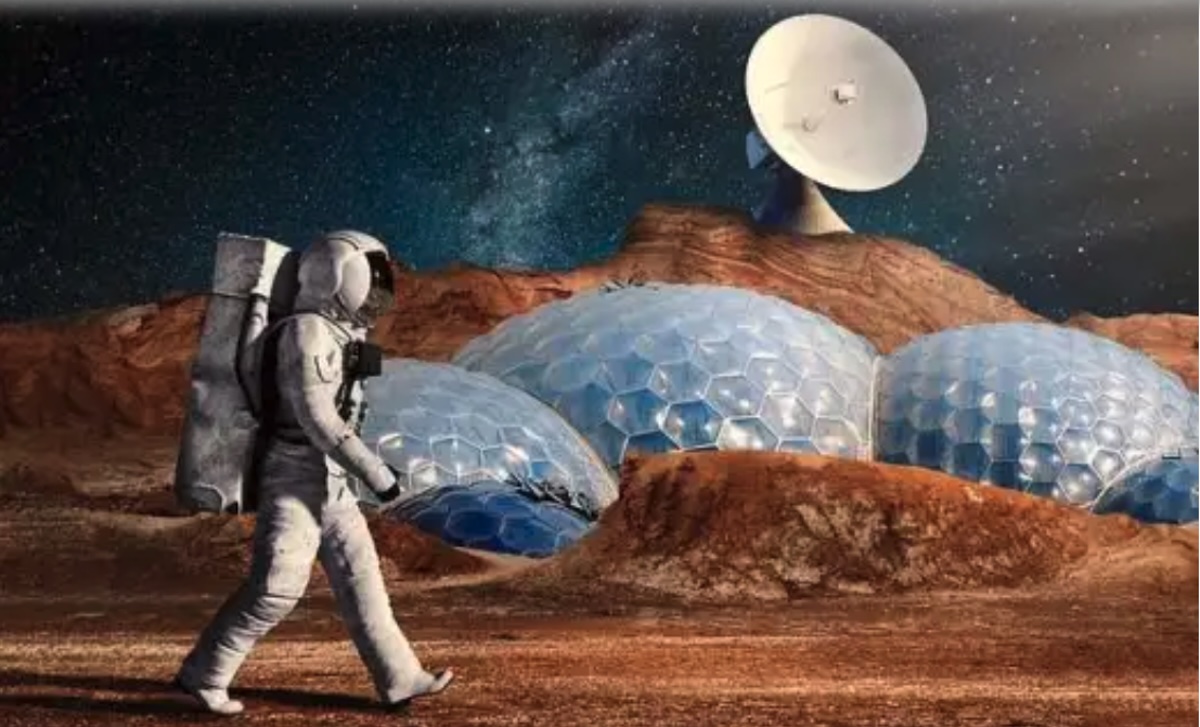
In a 1961 article in the Science Journal, astronomer Carl Sagan proposed an idea to influence the global environment of Venus by growing trees.8
Scientists are now considering planting trees and other vegetation on Mars as a process of terraforming the planet.
Terraforming would require CO2 and water vapor for trees to flourish, and bring the oxygen level up to 21%, as we have on Earth. Mars' atmosphere is 95% CO2, so this plan seems feasible.9
Some types of trees may survive the colder temperatures on Mars. For example, Apple trees are known to grow in cold climates and survive under a blanket of snow.
In addition to planting trees to produce oxygen, other technologies are available to produce oxygen. Scientists on the International Space Station are experimenting with growing plants in Martian Greenhouses that mimic those on Earth.10

An experimental process called solid oxide electrolysis will produce pure oxygen from the carbon dioxide that's present in the Martian atmosphere. Since there is an abundant 95% supply of CO2 available, this can have significant results.
The experiment is named MOXIE (Mars OXygen In Situ Resource Utilization Experiment). It has been reliably producing oxygen since April 2021.11
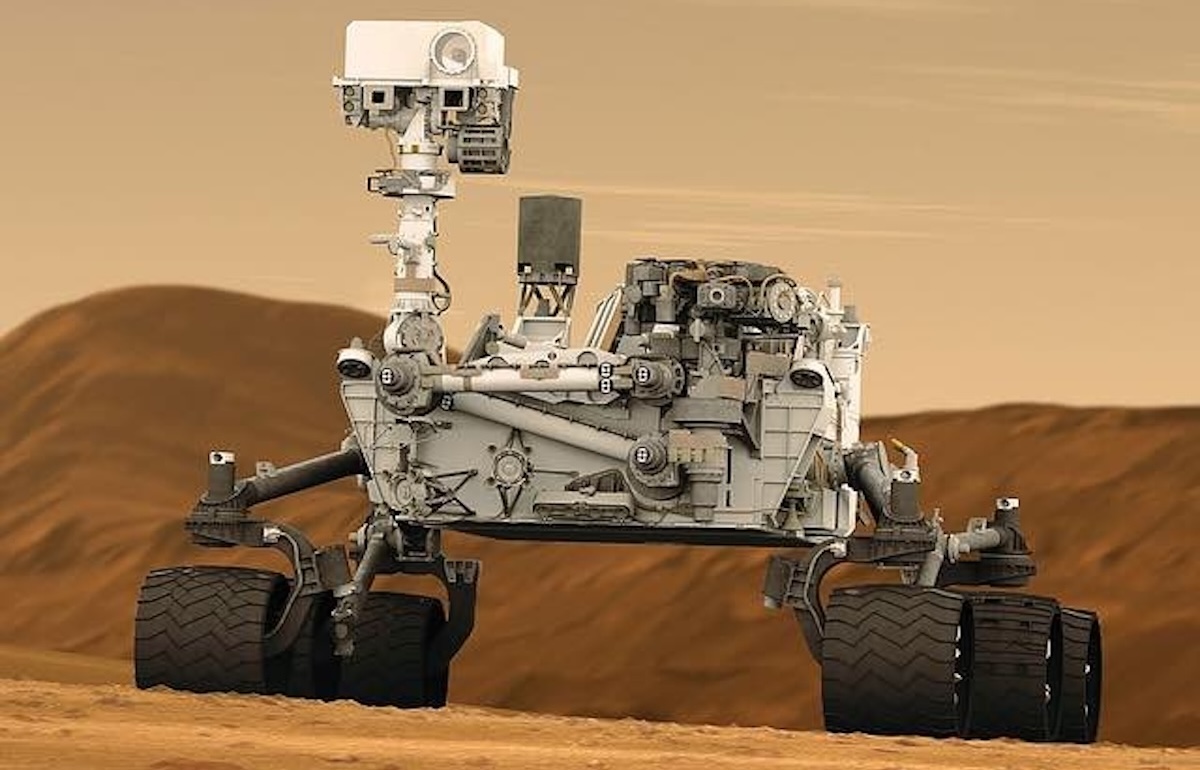
Since 2015, NASA has been putting a lot of attention on all the prerequisites necessary for a successful mission.12
They have used robotic pathfinders, such as rovers Spirit and Opportunity, to map the surface of Mars and find destinations for upcoming human missions. These rovers do the following jobs:
In March 2021, NASA successfully flew a helicopter on Mars despite the thin atmosphere.
That gives us a more efficient way to analyze the terrain. See how it works in this narrated documentary video:
The astronauts would not be returning to Earth. Some people in academia call this a suicide mission. However, if they succeed at living out their lives on Mars, I would consider it a relocation plan. The purpose, after all, is a permanent settlement of a human colony.
Those who go will have accepted the fact that they will have no family or friends other than the crew involved in the mission. In the case of an illness, survival would be dependent on the medical team, which would include a doctor and a surgeon.
Robotic surgery could be performed remotely by surgeons on Earth with the "Da Vinci Surgical System."
The only issue is the 20-minute delay with data transmission. However, that might be solvable with autonomous surgery. That could handle tasks during delays with a remote control.13
Living on Mars will never be like that on Earth. A method to protect the human body from cosmic radiation will continue to be a concern, requiring special living quarters and protective suits when venturing outdoors. Underground communities might be the solution.
Some scientific studies contradict other discoveries. In July 2018, the results of prior missions indicated that there was not enough CO2 remaining on Mars to create greenhouse warming.14 But that might be disproven with later studies being conducted.
NASA also claims that terraforming is not possible with our present technology. But they are moving ahead with plans based on newer studies anyway.15
With the Helicopter Ingenuity, the Perseverance Rover, and the Odyssey Orbiter mapping Mars, many pieces of the puzzle are falling into place.
NASA continues investigating Mars with further analysis of the atmosphere and rock samples. As the work continues, we can only imagine our future generations of people moving to Mars.16
In the following TED Talk video, Stephen Petranek discusses how our kids might live on Mars.
Was this article helpful?