
Last updated March 22, 2026 — Revised for clarity.
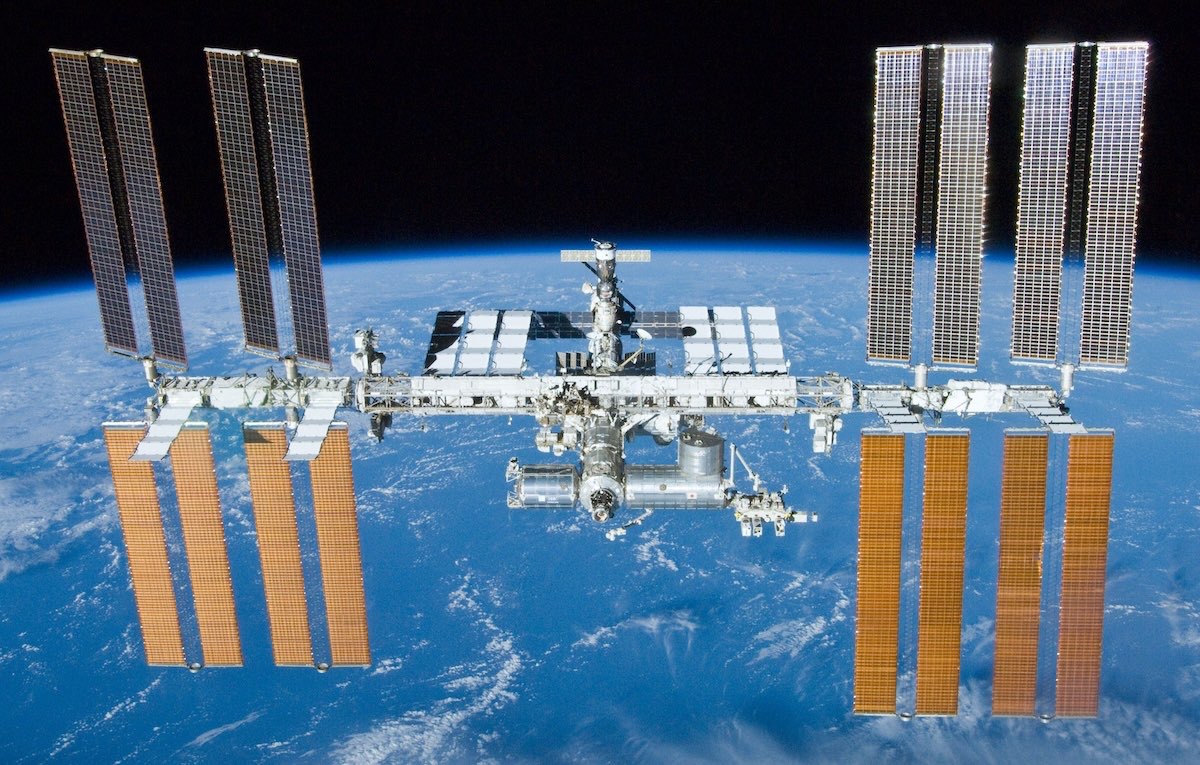
Astronauts on the ISS are scientists and engineers who help study human survival and endurance in space. They conduct science experiments in space and learn how to tolerate more extensive voyages planned for the future. Videos included.
They do research projects and investigate life without the conveniences of gravity or the conditions we take for granted on Earth. The work may lead to knowledge of colonizing the Moon and possibly Mars.
NASA placed the first module of the ISS in low Earth Orbit in 1998.
That's an average altitude of about 248 miles (or 400 kilometers) above the Earth. It circles the Earth every 90 minutes.1
The ISS consists of 14 pressurized modules, which astronauts added one by one. These modules contain science labs and living quarters. Eight solar arrays provide 75 to 90 kilowatts of electric power.
The external trusses and solar arrays were brought to the ISS by Russian Proton and Soyuz rockets, American Space Shuttles, and Elon Musk's SpaceX.
The cost to build and maintain the ISS was over $150 Billion, with the United States paying more than half that cost.
The ISS is continually falling back to Earth. However, it remains in orbit because of its speed, known as "orbital velocity."
This speed (close to 18,000 MPH) makes it perfectly balanced between the gravitational pull and its forward thrust around the planet.
Orbital velocity is what causes the Moon to stay in orbit around the Earth and the Earth to remain in orbit around the Sun.
There are sometimes up to ten crewmembers inhabiting the ISS at one time. Most countries refer to their crewmembers as astronauts. The Russians are known as cosmonauts.
It truly is an international expedition, as they are from the United States, Russia, Japan, Canada, and other European Partners.

Each astronaut has an expedition that lasts about six months to complete their mission, although three to ten crew members are on board at a time.
They can stay on board for only six months because life in space takes a toll on the human body. However, astronaut Mark Vande Hei remained for almost a year.
He returned to Earth in March 2022 after 355 days on the ISS.2
Extended living arrangements on the ISS help to collect vital data about the impact of living in space on humans.
That data is useful for determining the impact of long trips in space. A trip to Mars, for example, takes two years when the planets are arranged just right.
Water is the most precious commodity, especially in a self-contained living environment where a new supply is impossible to attain. Therefore, all wastewater needs to be collected and recycled. That includes sweat and urine.
Perspiration is collected from sweaty clothes and removed from the air. An aesthetically appealing name has been made up for the water collected from perspiration: Humidity Concentrate.
About 94% of all the wastewater from the astronauts is recycled. Interestingly, 85% of the water in urine is recycled using distillation.
Oxygen is replenished by separating it from the water through electrolysis. I used to do that as an experiment in high school science class. We learned that water is chemically made up of two hydrogen atoms and one oxygen atom. That's why it has the chemical name H2O.
The process is done by inserting electrodes in the water with a Direct Current (DC as opposed to AC). The DC splits the water molecules into their individual atoms.
The negative electrode collects hydrogen gas, and the positive electrode collects oxygen.
Besides oxygen, other atmospheric components such as nitrogen, carbon dioxide, hydrogen, methane, and humidity are monitored and controlled by a device called the Major Constituent Analyzer.
Each astronaut has their own personal quarters, known as a crew cabin. That is the only place where they have privacy, and they spend their alone time in there.
Each crew cabin contains a sleeping bag and personal effects. They are small, just big enough for one person.
WiFi is available on the ISS to send emails and communicate with friends and family back home. They use laptops to keep notes and write about their thoughts and feelings.
When they sleep, they usually use sleeping bags so they don't float around. The sleeping bags can be attached to a wall or upside down on the ceiling.
Remember, there is no up or down in space, and they can sleep in any position in their cabin.
They generally sleep eight hours to get a good night's rest for another busy day.
Astronauts do need to get haircuts occasionally. Female astronauts tend to leave their hair long.
The men get haircuts with a buzz cutter that has a vacuum machine attached to it to catch the hair as it's cut off. Otherwise, the hair would float away, since there is no gravity.
When brushing their teeth, they need to keep their lips closed. Otherwise, the saliva and toothpaste will float out. Not a pretty sight.
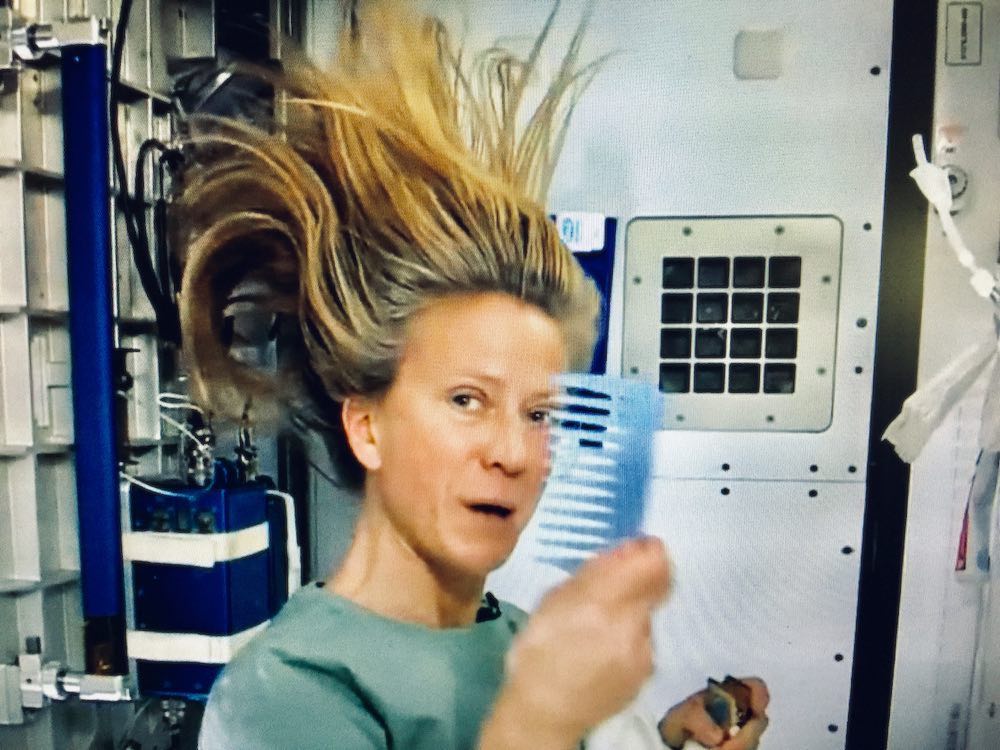
The lack of gravity also rules out running tap water. It would just float around the space capsule. Therefore, they wash their hair with a no-rinse shampoo.
Watch how astronaut Karen Nyberg washes her hair aboard the ISS:
The lack of running water makes eating very different from how we do it on Earth.
Food is dehydrated or freeze-dried and stored in plastic packages. The astronauts squeeze water from stored water bags into the food packages before eating.
They use hot water to make hot meals. And freeze-dried fruit can be eaten dry.
Astronauts need some free time to relax, and they get weekends off. Social activities are crucial for getting along with other astronauts and involve watching movies, playing cards and other games, and generally having a good time.
At times, individual crew members might relax alone, playing music or reading books.3
Astronauts lose muscle tone while in space due to the lack of gravity. Even the heart will weaken to the point that it fails if one spends too much time without the resistance force of gravity.
The solution is to exercise against the resistance of elastic ropes. Think of it as running on a treadmill with oversized rubber bands holding you to the mill. The same is done with stressing every part of the body.
The astronauts need to exercise for two and a half hours each day, lifting weights.
You're probably wondering, weights would be weightless in space. And you're right! Astronauts do it by pulling or pushing against the resistance of springs or elastic bands.
Astronauts keep a record of what they eat so NASA can keep track of everything. How many calories, protein, and how much salt they are getting, and so on.
Everything needs to be monitored and tracked with accuracy. The computers record their heart rate when they are working out. They even have to keep a record of when they use the toilets.
Both urinating and bowel movements need to be handled in a completely different manner in a weightless situation. You wouldn't want that stuff floating away from you.
A vacuum system is built into the special toilets. Astronaut Samantha Cristoforetti shows how space toilets work in this next video.
Officially known as "Orbital Debris," space junk is a real concern. People don't only pollute the land and oceans. They pollute space, too.
This junk consists of over 100,000 pieces of discarded satellites and rockets, and is increasing.
Although roughly only 27,000 pieces are tracked by global Space Surveillance Network (SSN) sensors maintained by the Department of Defense.4
A primary concern of orbiting space debris is that it can be deadly if any of it strikes the ISS. A solution tested in labs is using two layers of shields around every part of the ISS. That is important for the crew's survival.
If small objects the size of a grain of sand were to strike, the outer shield slows it down and causes it to dissipate so that it's too weak to penetrate the second shield.
Space junk is monitored by mission control. NASA continually adjusts the path of the ISS with jets to avoid these larger pieces. That's done from ground control so that the astronauts don't even have to think about it.
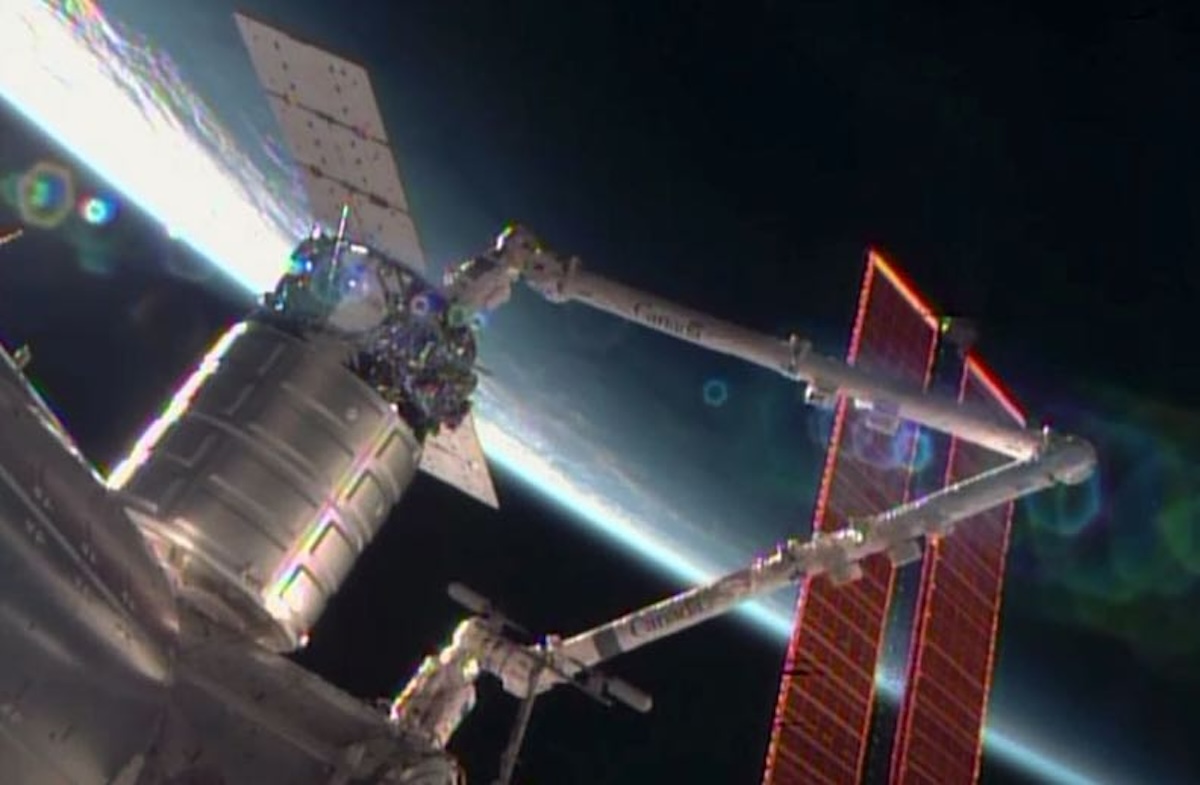
NASA uses a space vehicle known as the Cygnus Orbital Delivery Capsule to replenish needed items. It's launched about every six weeks, containing groceries, clothing, and new science experiments.5
Once the Cygnus Capsule is within 10 meters of the ISS, they use a robotic arm to capture and guide it to connect with the locking hatch. The astronauts can then open the hatch and enter the capsule to get all the new goodies.
A clean living environment is essential on the ISS, especially in such a cramped space.
Once a week, they go around with a vacuum, but they also need to clean everything with a wet wipe that kills germs. And they use the wet wipes to clean their eating utensils, their forks, spoons, and trays.
Waste accumulates among the astronauts just the same as our trash builds up in our homes. They deal with it the same way, filling garbage bags.
The bags also contain dirty laundry since they can't wash anything. They wear clothes much longer for that reason, but then they dispose of them with the rest of the trash.
They store those garbage bags in the Cygnus Orbital Capsule, which takes the trash with it when it leaves.
When Cygnus enters the Earth's atmosphere, it burns up, just as most meteorites do, and all the trash burns up with it.
The SpaceX Dragon Capsule6, which also delivers supplies to the ISS, has the added advantage of successfully returning 5,400 pounds of science equipment and other gear in March 2017.
Equipment and experiments that need temperature control are kept cool by a cooling pump attached outside the ISS.
If that pump fails, mission control can try to repair it remotely. In some cases, that's not possible, and a couple of astronauts need to conduct a spacewalk to fix it.
Spacewalk to Fix the Cooling Pump
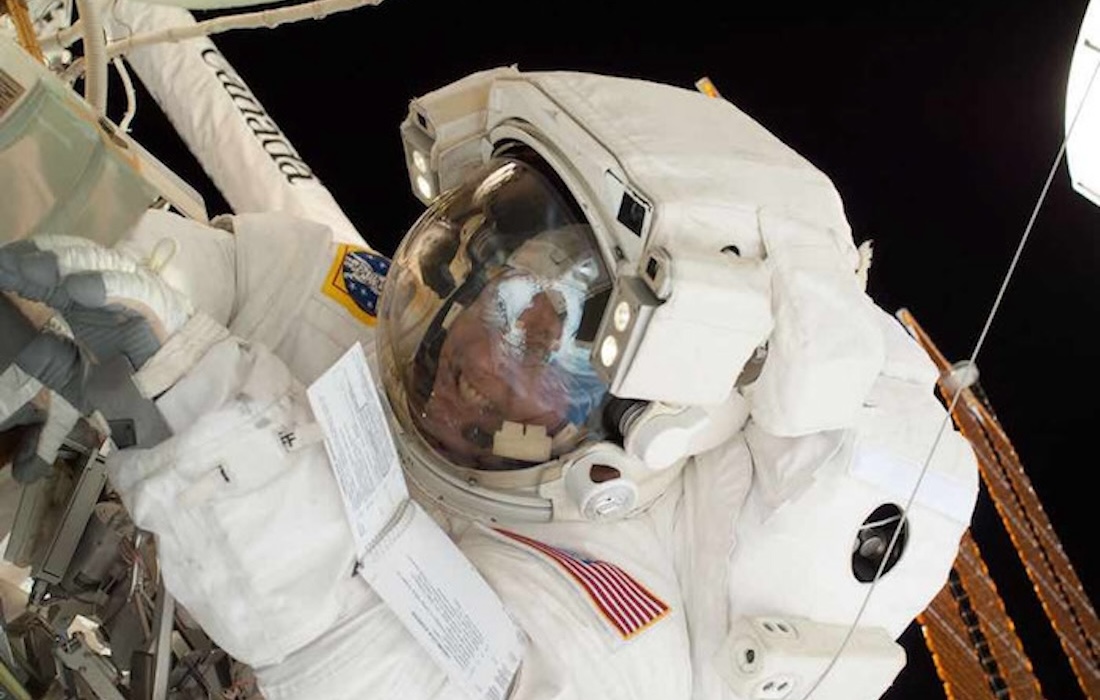
For a spacewalk, astronauts wear a spacesuit, which serves as a life support system. It includes the ability to hold waste if they need to relieve themselves.
While working outside the ISS, they have no sense of touch since they are in their spacesuits.
They hold onto hand grips while they inch their way along to the cooling pump to replace it with a spare.
That cooling pump weighs 800 pounds, but carrying it is easy since it's weightless in space. However, they need to be careful not to rub anything that might tear their spacesuit.
One thing they have no control over at all is the concern about micrometeoroids. These tiny particles can hit their spacesuit at any time, and there is no way to avoid the possibility.
Scientific lab experiments are continually carried out to learn how crops will grow and how animals are bred in weightlessness.
These experiments are conducted in anticipation of journeys to other planets.
For example, ants are studied to learn how they handle weightlessness. They get confused as they fall and float around.
Varieties of vaccines are also tested to study how they develop in a weightless environment.
In this video from the CBS News Program "The Talk," broadcast on January 18, 2011, NASA Flight Engineer Catherine "Cady" Coleman discusses daily life on the ISS and how she feels about being away from her family.
After two space shuttle missions with 159 days in space, Cady left the International Space Station on May 23, 2011, at the age of 50, and is now a retired astronaut.
Was this article helpful?