Last updated May 12, 2026
This article will help you choose the right surge protector. What joules rating you really need to protect your computer and electronics from power spikes.
Under normal conditions, electric lines have a steady voltage (120 volts in the United States). However, erratic fluctuations can occur.
These are surges in the electric power with voltage spikes that can damage your equipment. Voltage spikes can come through the power line and the telephone line.
Any voltage surge needs to be redirected to ground. That's what a surge protector is designed to do.
Your computer stores your financial information, business data, family pictures, and irreplaceable personal files. So it's crucial to get the best surge protector. Excellent protection doesn’t have to be expensive.
Lightning is well known for creating voltage spikes. But power surges can also come from high-powered equipment on the same circuit. These can create huge spikes in the electric line when you turn them on and off.
For example, if you have a refrigerator or air conditioner on the same line as your computer, you may get voltage spikes that can damage the machine.
Sometimes it might cause the computer to reboot, but it can also cause a hard disk crash that cannot be recovered from.
The standard surge protector will not protect your equipment from lightning strikes. If this is a problem in the area where you live or work, you need to consider full-building protection with an external lightning arrestor that diverts lightning strikes to ground.
Check with your power company and your telephone company if you are concerned about lightning strikes coming through your building’s electric wiring.
Ask what precautions they have taken to protect you and what recourse you have if their lightning protection fails.
Many people buy surge protectors with inferior clamping voltage that provide little protection from damaging voltage spikes. You need to pay attention to two things:
You want to have a low clamping voltage threshold. Anything greater than that would be considered a dangerous voltage surge that needs to be filtered out to avoid equipment damage.
The standard clamping for a 120-volt line is 330 volts. So, don't buy anything that allows more than that through.
You also want a surge protector that can absorb as much energy as possible before blowing itself out. Measured in joules, the higher this number, the more often your surge protector will survive voltage spikes.
If this absorption rate is too low, you may only be protected from a single event. Then you will need to get a new surge protector.
Unfortunately, that's another mistake many people make. They don't realize that a surge protector will not protect them indefinitely.
Cheaper surge protectors with a low joule rating only provide protection once. After that, it's like blowing a fuse.
You do indeed want to protect your equipment, but you also don't want to keep buying a new surge protector each time it saves you from a power surge.
A surge protector with a high joule rating will survive many power surges. So they will continue protecting your equipment.
I suggest a surge protection rating of over 3000 joules. With anything less, your surge protector may not survive a spike. Therefore, it may not protect your equipment if you get more than one high-voltage spike before replacing it.
A single high-voltage spike may destroy surge protectors with a low joule rating. You'll need to replace these cheap protectors often because they only protect your equipment from a single surge.
You'll save more money in the long run by using a good surge protector with a high joule rating in the first place.
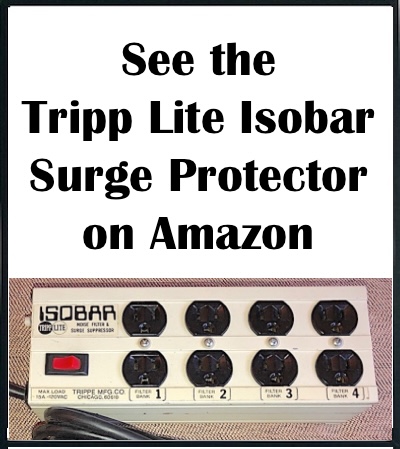
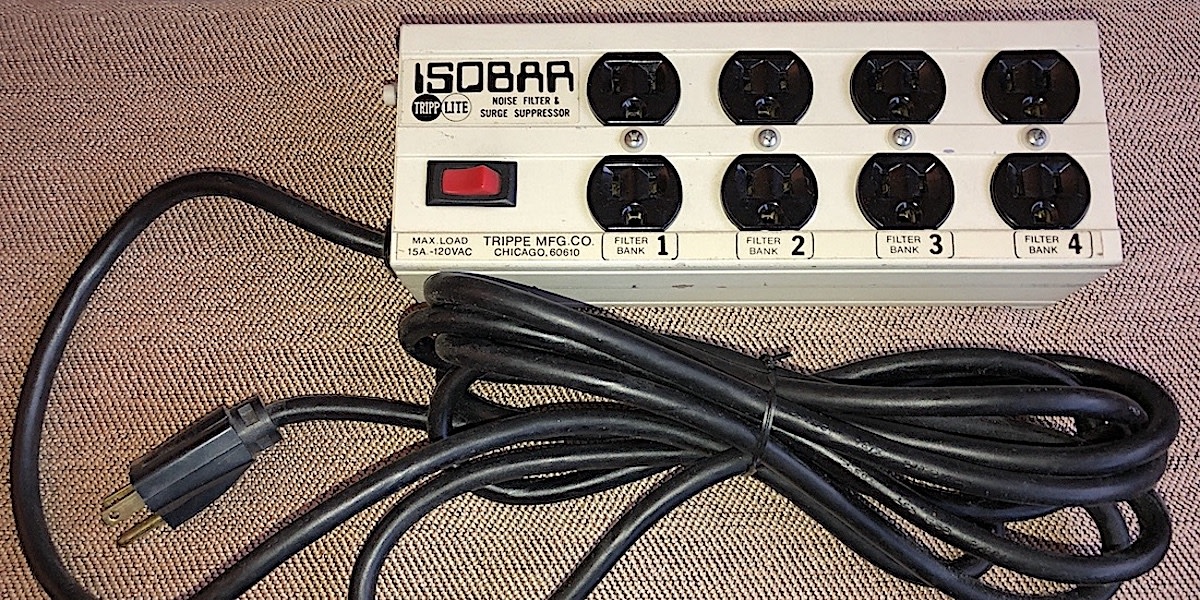
I recommend the Isobar by Tripp Lite. It's a power strip with surge protection rated at 3840 joules. It has eight outlets and room for large transformer adapters.
It’s so good that Tripp Lite includes a lifetime limited warranty and $50,000 Ultimate Lifetime Insurance to cover any connected equipment damaged by a power surge. See insurance details in their listings on Amazon.

If you have a lot of sensitive equipment throughout your home, you may want to consider a whole-house surge protector.
That needs to be installed by an electrician. It could help save everything else that wouldn't have been protected otherwise, such as your stereo equipment.
In addition to damage from lightning strikes, voltage surges from other sources can come through your electrical system, too.
You never know where it will strike, and protecting your entire building is the best choice when you have a lot of expensive equipment throughout your home.
Question:
Should I protect my kitchen appliances with a surge protector?
Answer:
Kitchen items such as a food blender or toaster oven don’t need protection. Besides, replacing these items if they ever do get damaged is cheaper than the cost of a surge protector.
Question:
How many joules are needed to protect a clothes iron?
Answer:
Surge protectors are mainly used to protect electronic equipment. I wouldn’t consider using one for ironing clothes. There is no need for that.
You wouldn’t be using your iron during a thunderstorm anyway. It is best to stay away from anything connected to electrical wiring that might receive a high-voltage spark from a lightning strike.
When selecting a surge protector, it's most important to pay attention to the joule rating (the higher the better, at least 3,000 joules) and the clamping voltage (basically around 330 volts).
Was this article helpful?