
Is it possible that the universe went through many trials, repeatedly being recreated from one big bang to the next, until the laws of physics and natural phenomena worked?
The most accepted theory is that the universe began with the Big Bang. However, was it a one-time event that worked perfectly, or had it failed many times, imploding into a black hole and starting over again?
All this couldn't have happened so perfectly entirely by itself. So much can have gone wrong with the Big Bang. So, was the universe created, or did it evolve?
1. Creation of the Universe
According to the theory of creation, there must have been a superior intelligent power in control that created the universe. The Big Bang is a one-time creation that had to be orchestrated by intelligence.
2. Evolution of the Universe
We know how all living species evolve because the fittest survive to reproduce. In the same way, the universe might have evolved from infinite random occurrences after each Big Bang.
Based on that hypothesis, the following two concepts need to be considered:
The concept of "infinity" has a lot of influence on the present state of the universe, assuming time is infinite.
Time has no beginning, and it has no end. If the creation of the universe were to repeat until one of the processes worked out just right, we might eventually get one that physically works.
A universe that may have locations (galaxies, solar systems, and planets) that support the creation and evolution of life. Possibly, that's the one we're in now.
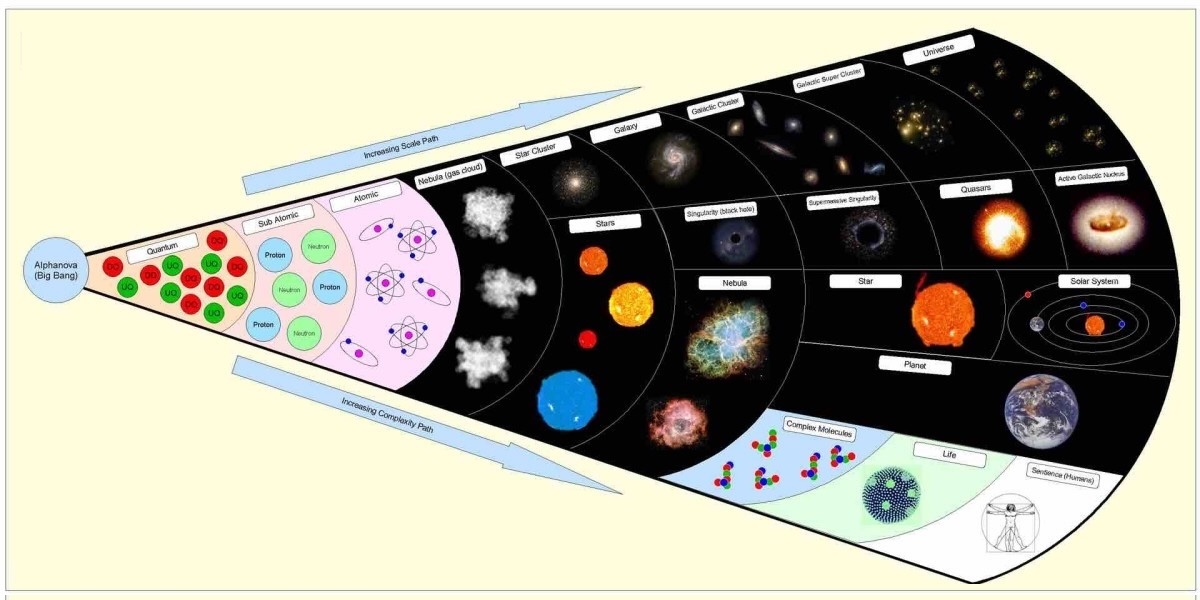
Every time a new universe is attempted, it could turn out differently, with survival of the fittest taking a solid lead. Therefore, one of the recurring universes that develops better would survive longer and be more productive.
For example, small planets in solar systems would be protected from asteroids due to the gravitational influence of larger planets farther out. So, that gives more time for evolution to mature.
Theoretical physicist and cosmologist Stephen Hawking explained what would have happened if the Big Bang were weaker or stronger:
So, was the Big Bang perfectly orchestrated, or did it just happen to be perfect after many trials?
Time may have always existed, even before and after the Big Bang. However, time may also cycle over and over again.
That theory would solve the puzzle of what came before the beginning and what occurs after the end because there is no beginning or end. It makes sense that the universe could be repeating in cycles.
Does that mean that everything in the universe eventually repeats? Maybe. But then again, maybe not. Perhaps things occur differently each time around.
In addition to that, there is an infinite number of cycles. Time cycles forever, each time repeating in a slightly different way. It can do this repeatedly, an endless number of times.
See my point? That can happen repeatedly. "To infinity and beyond!" — as Buzz Lightyear said in the movie "Toy Story."
The theory of Eternal Recurrence discussed in "Philosophy Now Magazine" implies that the universe repeats its creation and demise over and over again.1
If this continues to happen into eternity, then future occurrences of the universe could have either of two results:
Each time the universe repeats, something different happens. The Big Bang doesn't explode with the same force.
If recurrences occur an infinite number of times, some of those universes would have very different physical laws. There's no telling how many alternate scenarios might develop.
Some could be with varying forms of life. We are carbon-based creatures. But who's to say that life could take on a completely different chemical makeup?
The question remains whether we will repeat our lives in each cycle. Will we have a similar experience to what we have now? We might have a different consciousness.
But who can say that life even exists in another recurring universe? Another consideration is that the universe would repeat from scratch each time. So, we would never be aware of a previous existence.
If we were to exist again in a repeated scenario, our lives could either follow the same path or repeat in many alternate ways. That is especially the case if each universe follows differing laws of physics.
With repetition involved, it doesn't take a higher power to make it work right. All that's required is repeating cycles from scratch with another Big Bang. Sometimes it works, and most of the time, it fails.
That can go on eternally until one or more repetitions conjure up life with a consciousness to notice it. We exist in this rendition of a universe.
There is even a chance that we will repeat our lives in an eternal recurrence of the universe, maybe even an infinite number of times. In some occurrences, we will repeat our mistakes. In others, we'll get it right.2
Was this meaningful to you? Tap