Last updated April 19, 2026 — edited for clarity.

This essay explores how people in the deaf community can think cognitively without words since they have never heard spoken language.
If one never heard speech due to being deaf since birth, how can they think without language?
I found convincing answers about languageless thinking within the Deaf community through a book by Susan Schaller, a teacher of American Sign Language (ASL).
Her book, A Man Without Words, is about the language development of Ildefonso, an Indian Mexican born deaf.1
Having lived in total isolation, Ildefonso never learned any form of language. Susan wondered how he could think without language, and she took it upon herself to teach him ASL so they could communicate.
I’ll review what Susan had learned from Ildefonso after giving him the capability to share his thoughts and feelings.
It seems to me that when we think, we imagine the sounds of the words. Would you agree that you hear in your head the sound of the words of your thoughts?
In Ildefonso's case, he never heard words. Therefore, he couldn't imagine the sounds as he thought.
Since he never heard anything, he was very limited in how he envisioned the world.
He didn't know that things had names because he never had to refer to anything for what it was. And he didn't even know that people had names.
As Susan continued to teach Ildefonso, he eventually learned that things have names. That was the beginning of his realization that people communicate by referring to things.
This meant he could use the names of things in his mind to carry out his thoughts.
He still couldn't have a spoken language, per sé, since he never heard speech. However, he was thinking. That became evident when he signed "dumb me" to Susan one day.
She was surprised that he had learned a sign on his own. It was just sad that it was a negative one about himself. Nevertheless, it indicated that he could reason with logical terms.
Without fully understanding his limitations, he realized that he lacked some ability.
He still didn't have language that had the sound of words, but he did have sign language that Susan taught him. That, alone, was sufficient for him to use for his internal thought process.
I learned something amazing from Susan's book. She described what occurred when two deaf people spoke, or I should say, signed, with one another.
They communicate solely by signing and gesturing with their hands and facial expressions. And they can exchange lots of information about their lives and backgrounds. The speed of that communication is amazing.
The method used is what Susan refers to as visual thinking. They can share thoughts visually.
The way the two of them used visual conversation showed that one could "think" the same way, visually.
I concluded that if one has no spoken language, they can still think with a visual interpretation.
Once Ildefonso had a rudimentary understanding of signing, he began to pick up new signs by noticing their usage in context.
That made me realize it must be the same as the way hearing people pick up new words when they hear them used in sentences.
People in the Deaf community don't consider themselves disabled because they can communicate with ASL, and with reading and writing.2
I became curious to know how they could learn this without hearing. A teacher of sign language told me that they learn from visual observation. After all, sign language is visual.
That applies to understanding and comprehension as well. Without the ability to hear and having no formal language, the only way to understand one's experiences in life is to visualize them.
With that ability, their thinking is done the only way their mind understands. That is, with visualizing the signing in their heads.
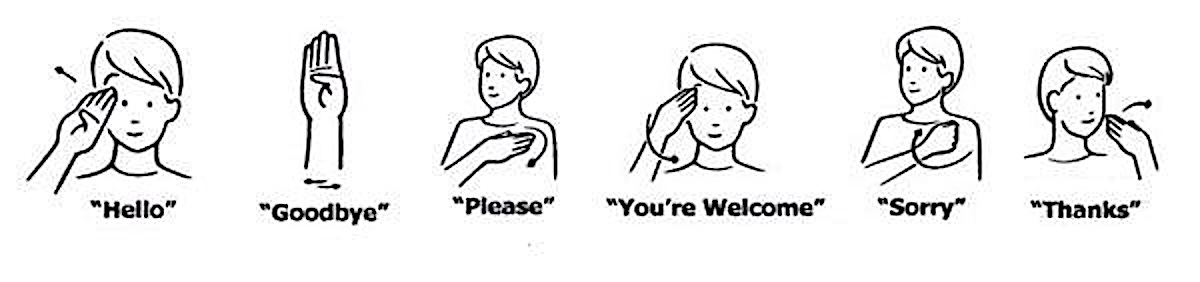
While teaching deaf students, Susan continued her research and found some other teachers who taught ASL to languageless children and adults.
Susan found a teacher named Dr. Virginia McKinney, who teaches deaf adults. Dr. McKinney had a student she called Joe, whom she began instructing when he was already 18 years old.
Joe could only make gestures to communicate. However, his language learning developed similarly to Ildefonso, who had started at a younger age.
That indicates that a person can learn a language even though they never had a language to think in.
In my opinion, they must be thinking in some way, obviously not with words, and probably not with symbols either.
Dr. McKinney shared a lot of information about her students with Susan. One of the most intriguing things I learned from Susan's book is that languageless people eventually have an "aha moment" when the symbols of ASL begin to make sense.
As Susan explains, they eventually have a moment of understanding when they realize the ASL symbols, and even written words, "carried something bigger than itself."
With that awareness of meaning and further language lessons, the students began to describe their early life experiences.
That proves that despite the late acquisition of language, they were thinking long before that. And they had saved their memories of the days when they had no language skills.

Based on my research of reports by teachers of languageless people, it's evident that something must go on in their heads, despite the lack of language.
It's a thought process that connects experiences with memory. That memory can be tapped later to communicate with others once they learn a language, either written or ASL.
What goes on in their heads is still a mystery. We can only imagine having thoughts with words because that is what we have done since we first learned to speak. The answer lies with those who were born deaf.
The story of Ildefonso intrigued me immensely as I learned that he was aware of social norms and conducted himself accordingly. He knew to make eye contact and respected other people's space.
He obviously acquired this knowledge without any form of language, so I wonder what went on in his mind. Did he think about it, or was it merely second nature?
If he did think about it, was it "visual thinking," noticing how people responded to his attitude?
How could he have formed those thoughts without the use of language? If it were just second nature, it must have developed in some way, either by observation or trial and error with positive and negative results.
Even that would require thinking, in my opinion.
What I read about Ildefonso and Joe clearly shows that they "thought" long before acquiring a language. That became clear to me when I read that they could explain what their lives were like before they had language skills.
They may not have understood everything they observed or what things meant, but they remembered the experiences. They were able to recall the memories later in life and could describe the experiences. That means they were aware and conscious during the time they could not communicate.
My conclusion is that they were thinking long before they had language. There obviously is a thought process that's not dependent on language as we know it.

Susan had lost track of Ildefonso as he moved on and made a life for himself. Years later, when she ran into him again, she discovered that language had changed him.
That became obvious when Susan met Ildefonso's brother, who was also deaf. The two brothers had developed their own version of sign language when they were young, and that's how they communicated.
Ildefonso's brother never advanced very much with language as Ildefonso had. As adults, the two of them had difficulty communicating because Ildefonso acquired language capabilities that his brother never understood.
Susan had tried several times to ask him how he thought before he had language. He never gave her an answer. Instead, he just needed to tell the story of his past.
I find it interesting that he could describe that time of his life to Susan, but never explained how he thought about things at that time.
I think that he just never understood the question. Whatever method he used to think was on a subconscious level. And he had no idea of it. The concept of "thinking" may have been so foreign to him that he could never explain it.
An American philosopher, Jerry Alan Fodor (born in 1935), offered a description of the thinking process first explained by Gottlob Frege, a German philosopher (1848 to 1925).
Their "language of thought hypothesis" stated that the structure of thought is a logical form of a sentence expressing the idea.3
We know how our thinking is structured with sentences—that's the case for hearing people who have acquired a spoken language. However, what is the structure of non-linguistic thinking?
I imagine that any thought process leads to some form of reasoning. So it shouldn't matter if one has language capability or not.
Thinking people behave logically and rationally, unless their thinking is flawed, which is possible. But that is another end of the spectrum.
In a related book that I read, Thinking Without Language, author Hans Furth asks, "What could count as evidence that a non-linguistic creature is behaving rationally?" 4
I found the answer is proven in Susan's book. She explained how many of the languageless people had healthy social interactions.
An obvious example was when Ildefonso felt bad about Susan giving him more expensive gifts than he could give back to her.
He also had a keen desire to learn and to seek constant employment. That shows he considered these things and was sensitive to the outcome of his actions.
That confirms that different cognitive processes are going on that are not dependent on language.
Ildefonso had many friends from childhood who were all deaf and languageless. He arranged for Susan to meet them in a friendly gathering.
I found this gathering to be a very educational experience that Susan described in her book. They all told stories of their past experiences. Of course, all the stories were mimed with signing included. Most of them never learned ASL, so they improvised with their own developed version of signing.
The communication was not always understandable, since they didn't share a common sign language. However, they all had a unique way of repeating stories and giving feedback to make things as clear as possible.
This method of communication was developed on their own with no help from teachers. They were effectively creating a language.
It's probably the closest thing to how cavemen first learned to communicate with speech. Only in their case, they used mime gestures and signing since, being deaf, they had no notion of sound.
How they thought and how they contemplated everything that was happening in their lives before having language amazes me.
Those with some hearing ability and those who become deaf later in life have the advantage of speech, but those who have never heard a sound have difficulty learning to speak.5
I wonder what their internal thinking feels like without knowing the sound of words. When you or I think about things, we hear the words in our heads. Don't you? I know I do.
I still find it bewildering that thinking is possible without language. But based on what I learned from the books I included in the references below, I've concluded that thinking can be achieved in many ways.
Our brain compensates for missing capabilities with remarkable adaptability. For example, blind people develop heightened senses of touch and smell. So it's understandable that those without language find alternative ways to think.
The experiences that Susan Schaller described in her book make that clear. She found many languageless adults who have what we would consider "normal" lives.
They have good jobs, they drive, have families, and they have their own clan of other languageless friends with whom they socialize, just as well as speaking people do.
Was this article helpful?