Last updated May 12, 2026

This discussion provides respectful support for the challenges women encounter regarding their abortion rights. If you're facing a difficult decision between parenthood and abortion, or if you know someone who is, read on.
A decision between pro-life and pro-choice should not be based on politics or other people's beliefs. In addition, the law should not force a decision one way or the other. Therefore, it's unfair to make laws that attempt to legalize or criminalize abortion.
It's disappointing how social and political issues get in the way of one's personal challenges where politics and law should have no part.
For some women, it's difficult to heal the trauma experienced after an abortion. Therefore, we need to understand and appreciate the challenges involved with making the right decision for one's own needs and concerns.
Making laws to control one's behavior without sympathy for their feelings is not the proper solution. Respecting personal choice with abortion without interference is crucial. But proper education to help make an informed decision is what's missing. And that is necessary to understand the emotions involved.
People often make the best decision they can with the resources and education they have at the moment. This article explains the need for education to help with a respectful solution.
As a least controversial solution, President Donald J. Trump attempted to solve the problem by letting the voters decide. Rather than making federal laws one way or the other with abortion, he made it possible for voters to select local politicians in each state who support their values.
However, that was not a complete solution because leaving it up to the states to make local laws would not support every woman dealing with the issue. The best solution would be to eliminate it entirely from the law and let every individual decide no matter where they live.
I can't stress enough how important it is to allow everyone to make their own choices with a life-changing decision. And that can only be achieved with proper education so each individual can focus on their emotional and psychological feelings when deciding.
This is complicated because both sides of the issue make sense.

Women have many reasons for choosing to have an abortion, and I'll list some below. Unfortunately, many reasons don't include understanding the emotional consequences. And that's why education is crucial. And that is where much of this process fails.
Here are some reasons women decide to have an abortion as mentioned in BMC Women's Health, a BioMed Central journal.1
It's crucial to understand how someone's mood and emotional state might be troubled for the rest of their lives if they made the wrong choice with regard to how they might feel later on.
They might later imagine how their child might have grown, gone to college, became an adult, advanced their career, and been a valuable part of society.
Of course, we never really know how our children would turn out. Even the best of parents fail due to external social forces that influence children as they grow up.
Nevertheless, one can dream and imagine an alternative life experience that leaves them feeling sad with regret. Interestingly, Dr. Vincent Rue, Ph.D, revealed that many men also experience grief and trauma following abortion as much as women in his article: The Hollow Men: Male Grief & Trauma Following Abortion.2
A woman's emotional well-being is at stake, but that can only be achieved with educational instruction, not by forcing decisions upon her. With suitable education, a woman can decide for herself what is the right choice with regard to her needs.
That education must include knowing how the procedure influences their emotional state, in the present and the future. For example, some women might feel emotionally troubled by their decision after years had gone by, and others may feel at peace with it. So there is no "one size fits all." No single course of action applies to every outcome.
Everyone functions differently with respect to their needs, so it's essential to respect the personal choices people make.
A women's right to decide the fate of her child or to make decisions about her own body needs to remain indisputable. After all, there are understandable reasons why women should be permitted to decide to have an abortion. Considering health concerns is one of them. Rape is another.
To the same extent, a woman needs to consider how the decision will have long-term effects on her emotional health. That is often overlooked.
So education needs to include knowledge of the psychological aspect. For example, one might regret their decision later in life. They might feel the stress of having abandoned their child. It could bring about sorrow and heartache, especially if they imagine their child growing up as the years go by. That experience can lead to depression.3
In that respect, people tend to think of their present emotional state when making a decision but do not consider the future. So before making any irreversible decision, studying the process and its psychological effects is helpful.

Abortion should always remain an option, but the decision must include informative details. Four things need to be addressed so women can make an emotionally healthy judgment call as to what to do.
Having an abortion enables women to achieve their personal life plans when having a child was not considered. And empathy will help make all this emotionally reassuring.
We often hear arguments based on pro-life, pro-choice, and pro-abortion. However, we don't consider how those decisions are based on educated conclusions.
Several specific scenarios are involved, so let's examine them.
1. Considering the Future Could Be of Great Consequence
Everyone will no doubt have different feelings as the years go by. But if they continue to imagine their aborted child in their life, they could be causing undue stress to their emotional welfare.
Some people think about how their child might have turned out as an adult. They might even think of their grandchildren as well. That could have been an entire family that didn't happen.
2. It's Our Flesh and Blood—and Soul
Depending on one's faith, there is the belief that part of our soul is eliminated when we terminate the life development of our own flesh and blood. And that could affect us emotionally, as these feelings can inflict long-term heartbreak for the rest of our lives when we long to know a child that could have existed.
Nonetheless, there are cases where that might never happen, such as not knowing the father due to rape. So it's clear why this needs to remain a personal choice. Only the individual knows how they feel, which must never be judged right or wrong.
3. Health Considerations Are of the Greatest Significance
Personal choice is crucial when facing pregnancy where the child's or mother's health is at risk. That's an obvious reason to abort the pregnancy, especially when a clinical diagnosis makes the danger of childbirth evident.
What if the fetus is known to have issues detrimental to a healthy, happy, and prosperous life? What about complications that might affect the life of the mother?
In some of those cases, it means fatality for the child, too. That must be considered if the mother could die when the fetus is still premature and wouldn't survive independently. So that makes perfect sense for abortion.
4. Rape and Incest Are Similarly Irrefutable
A similar reason for choosing an abortion applies if the pregnancy was the result of rape or sexual assault. In that case, the background and health of the rapist may not be known. So the child might be destined to live a difficult and challenging life due to a father's possible drug addiction or passing on adverse traits.
Incest, too, is a valid reason to question bringing a child into the world. Not only is there the emotionally devastating taboo element, but there are also health considerations here, as well.

If an abortion is put off too long while the embryo develops, one might reconsider it when they learn that the fetus already would have a heart that beats rapidly under the stress of having its limbs torn off to remove it from the womb.
That occurs when it already has developed a brain and nervous system that senses the pain of its body being ripped apart. Not to mention lungs that couldn't scream for mercy yet because the first breath is only at birth. 4
Nevertheless, a mother's emotional needs are significant, especially if she is alone or involved with an uncaring mate who has no concern for her welfare—or worse, due to rape. It's understandable how one's feelings take a different path under those circumstances.

Since this article is focused on the missing solution, the educational aspect in the decision-making process, knowing when a fetus is alive and feels pain, is crucial to making a decision that won't haunt one many years later. So, let's review when life begins.
To define life, we need to describe death. The definition of death has changed with new discoveries. For example, death was once considered when the heart stopped beating. But now death is defined as when no brain waves exist.
If death is defined as having no brain waves, then life should be defined as having brain activity.5
Therefore, we might say life begins when a fetus can feel pain—when it has developed a functioning nervous system and an active brain that interprets pain signals.
However, there is much controversy in the medical community about when a fetus begins to feel pain. I found a credible review of this in a recent article in WebMD. 6
Here is what I learned from that review:
Some scientists say a fetus can begin to feel pain at 12 weeks. However, others in the medical field believe it takes up to 24 weeks (end of the 2nd trimester) before it feels pain.
It's known that the brain is developing at five weeks (see "Fetal Development Timeline" below), but the disagreement is due to not knowing for sure if the brain and nervous system need to be fully developed to feel pain.
One thing known for sure is a concept called nociception. That is the ability to perceive harm and trigger a stress response.
So, when a baby's heart rate increases as a stress response to the abortion, does that mean it's feeling pain and is aware of what's happening?
The answer is questionable because we don't know if feeling pain requires awareness. And we don't know if the fetus is truly aware yet. So, the stress response to being aborted might just be what it is—a stress response without awareness of pain. Scientists simply don't know the answer to this yet.

Pregnancy begins at conception, which is when a sperm fertilizes the egg. That is typically two weeks after the last period.
Doctors usually include the two weeks between the last period and the time of fertilization to predict the date of birth. The following timeline refers to the weeks after conception (fertilization).
Data are summarized from the Mayo Clinic. 7
Norma McCorvey, better known as "Jane Roe" in the 1973 Roe v. Wade legal case in the U.S. Supreme Court, admitted the truth on her deathbed. She explained that the case was a deception to change the law and revealed pro-life groups paid her to act as the plaintiff, arguing against the decision that banning abortion was unconstitutional. It turns out she was really in favor of allowing abortion.8
After Roe v. Wade was overturned on June 24, 2022, many corporations in America began paying people to end an unborn child's life.
Why don't they consider including other options so women can choose what's best for themselves? There is one that I found. Peter Rex, CEO of Rex, which invests in tech companies, says his firm pays $7,500 to employees if they have their baby and give it up for adoption rather than consider abortion.9
Abortion is not the only solution. One can put the child up for adoption or let foster care find a home.
In some cases, abortion wouldn't feel right, if one's belief system considers the child the mother's flesh and blood. So, to avoid sadness and depression over the decision later in life, this is a viable alternative.
A helpful resource for this is the National Council for Adoption. They help find nurturing families while respecting all cultural traditions and values.
This option is especially pertinent for the following two cases:
1. Poverty
When pregnant women live in poverty, bringing their child up in such a situation might not be in the child's best interest. With limited financial resources, it is understandable how difficult it would be to provide a stable life as needed.
2. Immaturity
If the mother is too young to care for the child or is alone because the father hasn't made himself available, it's understandable that keeping the baby would be detrimental to its well-being.

Sexual reproduction is nothing short of a miracle, creating a new being that forms its own thoughts and develops its own ideas.
It's fascinating that we know famous people who almost didn't make it into our world because their parents were contemplating abortion. Here are some examples:
Steve Jobs (born February 24, 1955):
Imagine that we might never have had an iPhone or any smartphone, for that matter. Steve Jobs, the founder of Apple, was unwanted by his unmarried biological parents, but they chose to put him up for adoption. He is proof that an unwanted child can ultimately become a responsible person who creates great achievements for the benefit of society.10
Cher (born May 20, 1946):
Cher's mother thought about getting an abortion but couldn't go through with it. So, Cher was born.11
Sean Lennon (born October 9, 1975):
Yoko Ono wanted to have an abortion, but John Lennon convinced her to have the baby anyway. And they named him Sean Lennon, who followed his dad as a singer, musician, and songwriter.11
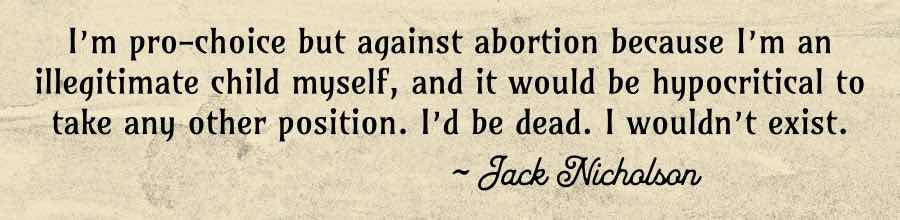
Jack Nicholson (born April 22, 1937):
We would never have known Jack Nicholson or seen his movies if his mother had gone through with an abortion.11
Justin Bieber (born March 1, 1994):
Justin Bieber's mother was only 17 when she became pregnant with him. She had suffered sexual abuse before becoming pregnant, and people told her to abort the baby, but she couldn't consider doing that.11
Brooke Shields (born May 31, 1965):
Brooke Shields' grandfather paid her mother for an abortion since having a child out of wedlock would risk his Social Register status. But Brooke's mother refused and used the money to buy furniture instead. 12
Many Others:
There are many more famous people we would never have known if their mothers had gone through with an abortion. Such as:

Reproduction can be considered a miracle. The traits of both parents become one, creating a new being that forms its own thoughts, develops its own ideas, and carries the parent's physical manifestation into the future.
The main point of this discussion was the emphasis on education. With that provided, as I had discussed, one would be better able to make the right decision in view of their personal needs. Social and political opinions should never get in the way of that choice.
The decision for an abortion needs to be based on a well-informed assessment. So the knowledge gained from suitable education would contribute to helping one weigh the pros and cons of any decision they make.
When the decision is left to the individual without outside influence, but with their own insightful awareness, whatever they decide will be the right choice.
Was this article helpful?