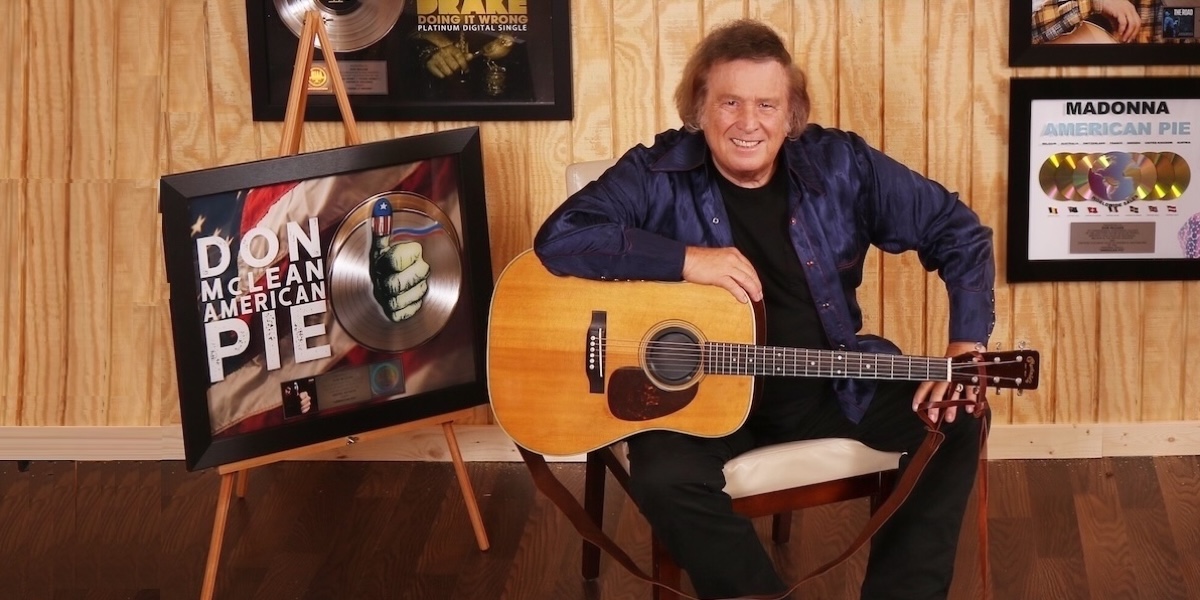
American Pie is a well-documented description of the tensions baby boomers experienced with the changing world of the 1950s and 1960s, with music nostalgia as the main theme.
When Don McLean lost his best friends and music legends, Buddy Holly, Ritchie Valens, and J.P. Richardson (The Big Bopper), in a plane crash on February 3, 1959, he felt it was “the day the music died.”
That inspired him to write the song “American Pie” in the late 1960s, which he released in 1971.
Don McLean’s knowledge of society and culture made this song a work of historical significance of the 1960s and 1970s. His passion for poetry made it a song to remember with his objective and analytical perspective on the events of that time as a comprehensive history lesson.
Don McLean wrote “American Pie” in a structured and organized poetic form with specific rhyme schemes. I appreciate poetry that rhymes, rather than free verse. So, I always enjoyed listening to it.
Little did I realize the power behind the words. I often overlooked the tremendous imagery an author was building for me to experience when I read or listened to poetry.
When I read a poem, I often have to stop and ask myself, “What does it mean?” Many times, I fail to understand what the author intended.
Great writers express powerful emotional feelings with creative and intense imagery. Don McLean achieved that with the way he wrote “American Pie.”
I listened to “American Pie” throughout my life, thinking it was just about the three rock and roll musicians killed in a plane crash in a farmland in Iowa while on the way to their next show in Moorhead, Minnesota.
However, I overlooked the meaning of all the significant words in the song. Instead, when I paid attention to it, I realized it was an educational history lesson on music, culture, politics, and social changes that occurred in the 1960s and 1970s.
Of course, he started with the lyrics “The Day the Music Died,” referencing one of the music legends' widowed bride.
"I can't remember if I cried, when I read about his widowed bride, but something touched me deep inside the day the music died."
He continues with references to American pop culture and 1950s hit songs such as "The Book of Love" and "A White Sport Coat."
In the next verse, he jumps ahead to 1969, clearly stating that in the lyrics:
"Now, for ten years we've been on our own and moss grows fat on a rolling stone."
He talked about how Elvis Presley temporarily lost the limelight with James Dean's efforts to be a rebel with a cause, singing protest songs during the troubled times of the decade.
"Oh, and while the king was looking down, the jester stole his thorny crown."
He left nothing out, even mentioning John Lennon's studies of left-wing politics.
"And while Lennon read a book of Marx, the quartet practiced in the park."
I grew up in the 50s and remember how we used to practice hiding under our school desks in case of a nuclear attack, as if that would have protected us from radiation. But McLean mentions that horrific time:
"Helter skelter in a summer swelter, the birds flew off with a fallout shelter."
He also talks a lot about Woodstock, the music festival that attracted over half a million people in August 1969, mentioning what was revealed about the unfortunate negative events that occurred during the affair.
"Do you recall what was revealed the day the music died?"
One thing that was left to our imagination was his reference to Martin Luther King, John F. Kennedy, and Robert F. Kennedy. His reference could have instead been toward the three rock and roll singers killed in the plane crash that the song is dedicated to.
"And the three men I admire most, the Father, Son, and the Holy Ghost..."
Becoming more aware of the messages in the rhetoric of “American Pie,” I have a better understanding of the time I grew up and how we experienced the world at the time.
I came away from it with an appreciation for the way famous songwriters contributed to the nostalgia and memory of the tensions and difficult times we baby boomers experienced as the world was changing.
I felt it would be helpful to include this 12-minute video that explains the details of “American Pie” very well:
Was this meaningful to you? Tap