
Last updated April 19, 2026 — revised for accuracy.

Discover the factors that contributed to the decline of once-promising content platforms: Bubblews, InfoBarrel, PersonaPaper, and HubPages.
Based on that, I foresaw the failure of these content platforms due to their poor business models while I experimented with posting articles on their platforms over the years.
Among their many problems, The following are the “worst case” issues of each of these platforms:
So, let’s review their individual details.

Bubblews was a content platform for writers who wanted to submit stories on anything. It was founded by Arvind Dixit and paid a penny for each view.
Short posts usually don’t get organic traffic since search engines don’t see any value in them. Even those who wrote more involved articles couldn’t reap the rewards of their efforts because the entire site had a low ranking. Spamming and low-quality posts were a big part of the problem.
They attracted people who couldn’t write a complete English sentence. Many spammers gamed the system, and Bubblews’ staff didn’t care.
Other problems included server outages and system crashes due to poor programming. When things went wrong, they made quick fixes without testing. That caused more bugs.
In July 2014, a system upgrade produced a disastrous bug. Anyone with more than one image in a post lost all the text after the second image. Many of us frantically edited our posts to put back the lost text.
What did management do? They considered the sudden rush by everyone editing to be the problem, so they removed the ability to edit posts. We were screwed.
Google eventually dropped those posts from the SERPs due to empty content.
When I was a systems manager, having worked in two major corporations, I never allowed my programmers to implement program changes without testing.
I noticed that every time Bubblews tried to fix one thing, they broke something else. Good programmers test their code thoroughly, and managers check to be sure it’s working.
With all these problems, it was evident that Bubblews was headed to failure.
It Was Evident Bubblews Was Headed to Failure
In all the time I was publishing content on Bubblews, I noticed they had a poor business model. The residuals payment system was faulty. They allowed spammers to game the system, and they failed to eliminate the cause of complaints the Better Business Bureau was accumulating.
Bubblews Reneged on Payments
In November 2014, Bubblews announced it would not pay residuals on redemptions made before that date. At that point, I immediately deleted all my articles. I had backups saved on my computer since I write everything offline. Many other diligent users also deleted their content.
The pending demise of Bubblews became clear on December 18th, 2014, when Arvind Dixit posted, “Bubblews has distributed over $1 million to date, considerably more than our revenues.” That certainly meant that they were out of money.
Bubblews Shut Down Its Platform Without Warning
The site remained online for another year without paying anyone. I never could understand why so many people continued writing without getting paid.
In November 2015, Bubblews shut down without warning. Shortly before that, they changed their policy, stating that anything posted on their site is their property and they retain the rights to use it as they see fit.
Many people didn’t pay any attention to that new policy, but I removed my content in time. A lawyer friend of mine told me that if we continue to post new content after they change the rules, we are showing agreement to those changes and have given away our rights.
It was apparent they never had a clear business plan, and they were winging it as they went along.
Bubblews Had a Failing Payment Model
Bubblews had a payment model where they committed to paying earnings before knowing the amounts they would receive. This is a business model destined for failure. They created their own algorithms to pay per view, per comment, or other user actions.
At some point, Bubblews discovered that certain countries did not bring in any revenue, so they refused to pay those users the amount that was already posted as their pending revenue.
Then it got worse. I can’t forget how Arvind Dixit once stated that due to a “ridiculous amount of fraud,” they would not pay anyone at all. Those of us who followed all the rules were in the same class as the spammers.
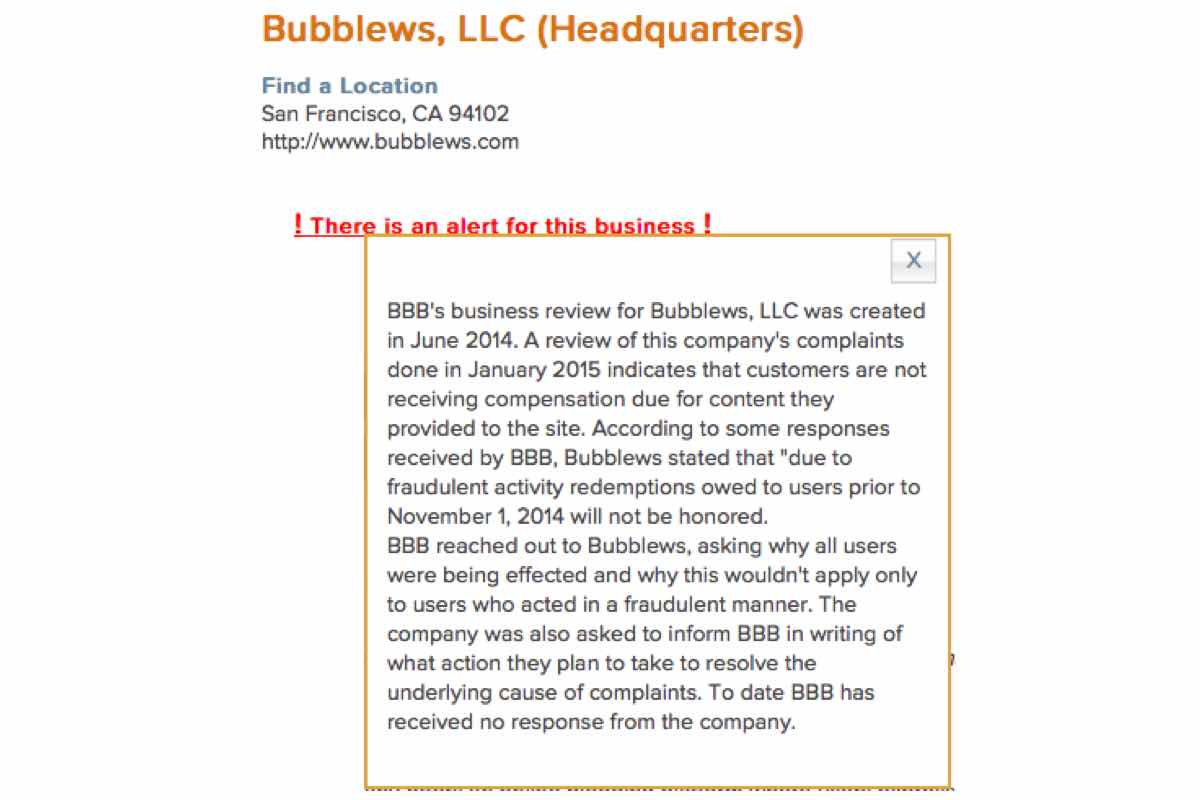
Many of us registered complaints with the Better Business Bureau when they stopped paying. I was one of them. The BBB asked Arvind Dixit to explain why he didn’t just hold payments from those who acted fraudulently. He never responded. Here is an image of an alert on the BBB website:
Did Bubblews Steal Rights to Our Content?
If authors deleted their posts before the policy change, they would have had rights to their work, since they posted in good faith under the prior terms of service.
In addition, as long as authors stopped posting new content after the policy change, they were still under the old rules that gave them rights to their content.
Many things Bubblews did were fraudulent, and many authors have records on file with the Better Business Bureau about the fraud and payments due to them. Me included.
A lot of content was left on the platform, and nobody had access to their articles when Bubblews closed down. So, management had control over all the material that was left there. Who knows what they had intended to do with it?
InfoBarrel was founded in 2008 for authors to write and publish articles. I found many unresolved problems when I created my account with them in 2016.
I discovered links to technical information that redirected the reader to the home page. That meant no one ever cared enough to complete the site’s setup.
In January 2021, their website was down for several days with a message stating they were upgrading and would be back online in a couple of hours.
Unfortunately, that lasted for several days, and I found numerous problems when they came back online.
I wrote to the admin about the bugs I found. He never replied, and people were posting in the forum that he seemed to be “missing in action.”
Writers Posted Many Complaints in the Forum
Many Writers Were Leaving and Closing Accounts
I noticed many author profiles were removed and linked to the home page instead. That meant people were leaving. Even new members who never got started had their profiles redirected to the home page.
Besides that, it was very unprofessional to redirect to the home page rather than display a meaningful statement.
In the case of a closed account, they should display something such as, “This user is no longer on InfoBarrel.” I guess they didn’t want to admit that was happening.
InfoBarrel had many unresolved glitches. I’ll describe all the problems I’ve discovered when using InfoBarrel and by reading posts from other users in the forums.
Problems With Payments Handled Manually
I found a forum post from the admin explaining how he lost track, messed up the payments one month, and tried to fix the mess.
In August 2016, some people saw a tremendous but short-lived increase in earnings. For example, one person commented in the forum that she saw $45 in her account, which was then adjusted down to $3.
Another person saw a whopping $900. He posted, “I doubt they’re genuine. I apparently am earning around $400 for every 1,000 impressions.”
Yes, indeed — that’s impossible. What poor programming! Assuming there is even a payment system being used. That forum post from the admin seemed to make it clear that he handled payments manually.
There Was No Delete Button
You had to contact the admin to request the removal of any article you wish to delete. Then it’s up to them if they oblige. Some people posted in the forum that they had to try many times to get a response — usually in vain.
Title Changes Caused “404 Dead Link” Errors
When one changed their title, the URL changed along with it without a 301 redirect to the new URL. That created a dead link, which returned a 404 page missing error code to one’s browser. Therefore, all prior links posted on social media and search engine indexes were broken.
A good practice is to make the URL static once an article is published, and it should never be changed unless a 301 redirect can be assigned.
Confusion With Pen Names vs. Usernames
When users added a pen name to their profile, their actual username was still displayed as the sender when leaving comments on articles. That made it difficult to know who someone was because it didn’t match the name in the author’s profile.
There Was a Bug in the CSS Code
A bug I discovered in the CSS code caused embedded YouTube videos to cover the surrounding text. I couldn’t even read the overlaid content on an article with this problem.
Amazon Canceled Authors’ Affiliate Accounts
Some members posted in the forum that they had lost their Amazon affiliate status because Amazon has started canceling affiliate accounts if they advertise on sites they do not own. InfoBarrel required members to use their own Amazon affiliate code. That was a problem.
To give you an example of due diligence, HubPages avoided that problem by allowing writers to use Amazon via their HubPages Earnings Program. Amazon issues unique affiliate codes for each user, but they are registered under HubPages.
You might think InfoBarrel could have done that, too, but there was a problem. Profile URLs looked like forum profiles because they had the word “users” in the URL. That was not a top-level domain, so that’s why Amazon canceled the affiliate accounts people used on InfoBarrel.
The people who lost their affiliate accounts had posted in the forum that Amazon was saying they canceled because they used their account on a forum site, which is against their terms of service. Once again, poor programming causes this confusion.
I last checked that particular issue in 2018, and the user profiles were still the same, remaining against Amazon’s rules.
InfoBarrel Blocked Google From Indexing Articles
Since I saw so many people complaining in the forum that Google is not indexing their articles, I decided to check their robots.txt file. This file instructs search engine robots on how to crawl their pages.
When I first checked that file in 2016, I found a Google directive denying search engines permission to index. That might have inadvertently been left there after a system update. It’s very unprofessional to miss something like that.
They eventually discovered their mistake and corrected it so search engines would index their articles again. However, when I rechecked this file on August 1st, 2018, I found the following directive:
Once again, they denied Google access, so articles could not be listed in the SERPs. However, other search engines, such as Bing, were not blocked this time.
They kept putting that directive back in robots.txt. I don’t know why their programmers did that! It serves no purpose that would be advantageous to its authors.
I checked a few articles by putting their titles in Bing, and they showed up as expected. But when I searched for the titles on Google, they did not appear in the SERPs.
Things changed quickly. A few days later, on August 6th, 2018, I noticed they removed the directive that disallowed Google indexing — maybe because they read my warning and were alerted to their mistake. Their updated robots.txt file finally had the following directive:
That statement is meant to show search engines where to find the sitemap. But instead, it refers to the home page of the site. In addition, there’s another problem. Their sitemap is a mess!
I looked at their sitemap.php file, and all it does is recursively point to itself. The links to the articles are missing. That is ridiculous! They obviously don’t know what they are doing.
The following was their sitemap file as of August 6th, 2018:
When I first experimented with the site in 2016, I emailed InfoBarrel’s admin, Kevin Hinton, asking if the staff was actively working on this site. I never received a reply.
Other people complained about the admin’s absence, which made me wonder if this is just a one-person shop. So, with further investigation, I discovered three people were involved with the business.

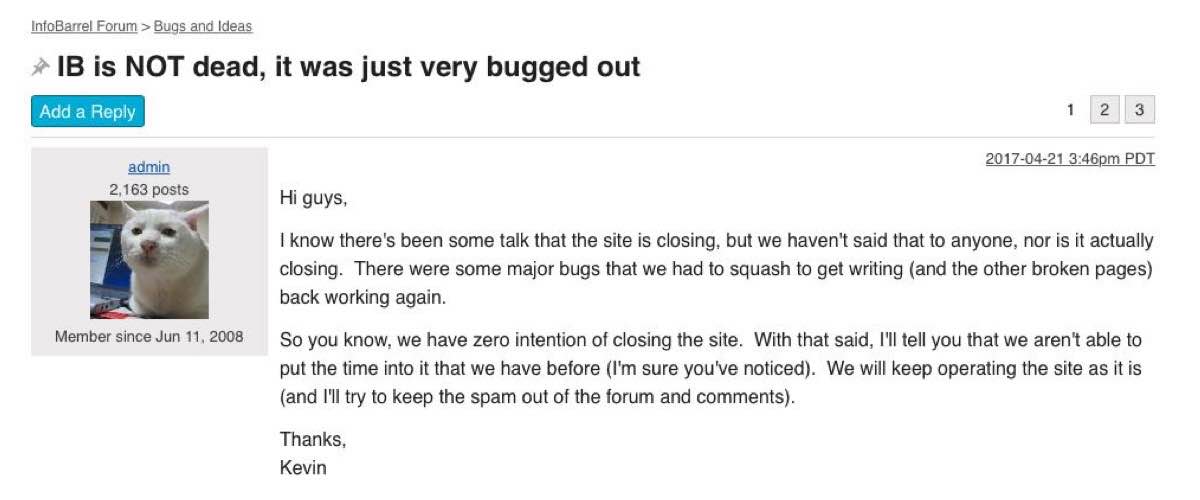
In April 2017, Kevin posted the truth about their affairs in the forum. He admitted that they were not able to put the time into it and would just keep operating the site as it is.
I was shocked at the incompetence when I checked in on things in mid-2020.
No Security Protocols Used
Every legitimate website began using the Transport Layer Security Protocol (TLS) a few years earlier. That provides three types of protection: Encryption, Data Integrity, and Authentication. You’ll know it’s secure when you use “https://” in front of the URL.
I noticed InfoBarrel is not providing a secure connection. The only way to get to it is with “http://” before the URL, which is not secure.
Author Payments Where Discontinued
In February 2020, InfoBarrel announced it could no longer pay its writers. Their excuse was that PayPal had eliminated the API used for making payments.
They claimed they were working on an alternative payment method, but admitted they didn’t have the financial resources to do that.
Site Down for Maintenance
As of January 2021, they’ve been down for several days. Offline for many days, and claiming it’s for updates is not professional.
The InfoBarrel Publishing Platform No Longer Exists
InfoBarrel’s web SSL security certificate expired on August 28, 2021. As a result, all web browsers now warn users that the site is not secure and block access to protect visitors from possible malware.
A year later, in September 2022, their SSL certificate had not been renewed. Some web browsers will allow you to bypass the security warning when visiting the site.
In that case, you’ll see a single page where Ryan McKenzie (remember him?) said they decided to devote all their attention to a new project. The entire platform for publishing online content has been removed.

PersonaPaper was started on March 1st, 2014, by Ashley (&Ashley). However, after a career change involving a lot of traveling, Ashley turned it over to Heather Lee Chapman (&MaeLou) and William Chapman (&elitecodex) to manage the business from their home in Port Charlotte, Florida. They ran it as a Sole Proprietorship.
PersonaPaper Accepted Useless Content
Many people wrote about their daily lives. One writer posted about waking up, having breakfast, and walking the dog. What’s the point of sharing that? I was surprised to see people were following her. Google finds no use for that, and it hurts the entire site’s ranking.
AdSense Canceled Their Account
Unfortunately, they did something that caused AdSense to cancel their account. That doomed them from the start. As an alternative, they began using other ad agencies, but some of those ads had dangerous links to malware sites.
Some ads even used malicious JavaScript redirects, taking advantage of browser exploits that automatically redirected visitors elsewhere. That only affected mobile users on an Apple iPad. But when I reported it, Will said he didn’t have the resources to buy an Apple iPad to check on this.
The red flags began to unfold.
One can appreciate the value behind the following four concepts. They were designed so PersonaPaper would never be plagued with spam or fraudulent activity.
1. Payment Based on Ad Revenue Exchange Rate
They paid in virtual coins that were presently worth $0.0015 per coin. The coins’ value was based on an exchange rate that was adjusted to the ad revenue.
Users could either cash out once they reached $20 worth of coins or leave it in their virtual bank and let it grow.
2. A Concept Designed to Avoid Hackers and Spammers
Two coins were earned for each unique view and one coin for each comment on other people’s posts. Nothing is earned for likes or comments received from others. I found this to be a unique concept designed to prevent hackers and spammers from gaming the system.
3. Motivating Reader Engagement
Payments for leaving comments motivated people to engage with the author of the articles. Comments needed to be written well with at least 30 characters — not just “Nice Post.”
4. Zero Tolerance Policy
Plagiarism was not tolerated and was closely monitored. Accounts were deleted if duplicate content was found.
They also carefully enforced the proper crediting of images used from other sites. When posting, one needed to complete an “image credit” section. Even our own photos had to be credited — to ourselves.
Despite their good business ideas, which I just described, Heather (&MaeLou) and her husband Will (&elitecodex) didn’t handle the system well.
Will was a programmer and the only one maintaining the site. I had reported several problems to him. The worst was malicious code used by one of their ad agencies that redirected Apple mobile users to their own product site by using a known browser exploit.
When I told Will about this, he said they needed to keep that agency because they paid a very high ad revenue. He obviously didn’t care to provide a reader-friendly experience.
In August of 2015, both Heather and Will were nowhere to be found. For a couple of months, no one could get a response to queries or for help.
Finally, on September 5th, 2015, Heather posted a message stating that they both became very busy with their personal lives. Gee, I thought this was a business!
Will also posted a message saying they are discussing their options about how they will be moving forward. At that time, I knew they wouldn’t be around much longer, so I stopped writing articles.
Two days later, Will posted a detailed explanation of the present state of affairs. Both he and his wife had full-time jobs and didn’t have the time to commit to PersonaPaper any longer.
Will also explained that they gave out more coins than they had the money to pay. I’ve been through that before. The same thing happened with Bubblews.
They discussed the future direction of the site and came up with two choices:
As of February 2016, PersonaPaper announced that they are shutting down — just as I had predicted. It was so obvious. They never followed up to fix bugs. They warned everyone five months earlier that they had run out of money. It was only a matter of time.
Unlike Bubblews, they at least had the courtesy to leave the site online so people could copy and save their articles.
A year later, in March 2017, Meg Learner purchased PersonaPaper to take over the entire business, the software, and the domain name. Even though she said writers would not be paid any revenue, she invited people to publish new articles.
Meg said she didn’t have programming knowledge, so she left the system functioning as it was.
There is no advertising, but there were errors throughout the site due to ad placement for unregistered ad agencies. I guess she didn’t know how to remove that code.
In addition, no one was being paid. Meg made that clear in her posts. However, she never knew how to change the FAQ and Terms of Use pages, which still said people get paid for content.
She needed to hire a programmer to manage the software, but that never happened since she had no money coming in from the business.
In 2015, Meg said she had a couple of advertisers in mind, but traffic was insufficient to attract advertising.
As of September 2022, Meg was still keeping the site alive under the above conditions. And the Terms of Use page was still never updated. However, by 2024, Meg had given up, and the platform was no longer online.
HubPages was doing well for many years with individual niche domains. That helped the Google algorithm detect the proper topic categories for the content.
Unfortunately, The Arena Group decided to eliminate allowing the niche domains for our use. And they moved all our articles under one domain, despite Google’s known Panda Algorithm that lowered the ranking of “content farms,” as they are known.
Interestingly, they kept those domains for their own content, which proved extremely profitable for the company, as indicated by a 600% increase in their stock (NYSE: AREN).
That single move put me on the alert that the end would come for HubPages, too. And I stopped writing for HubPages and didn’t pay much attention to the site anymore, since my time was better spent creating my own content website.
The announcement of HubPages’ demise had been posted by staff in November 2025, with a shutdown date scheduled for January 2026.
When a writing platform displays ongoing problems, it’s crucial to consider if the time spent writing on that platform is worth it.
It’s also important to observe how strongly management is willing to keep up with the latest SEO trends, and a willingness to make it rewarding for writers to create valuable content.
I’d rather write on a platform that functions on a professional level. It’s hard to find anything that matches the integrity and professionalism that HubPages once offered before The Arena Group took over.
Was this article helpful?

